Tree Trimming vs Tree Removal: Which Is Right for a Storm-Damaged Tree?
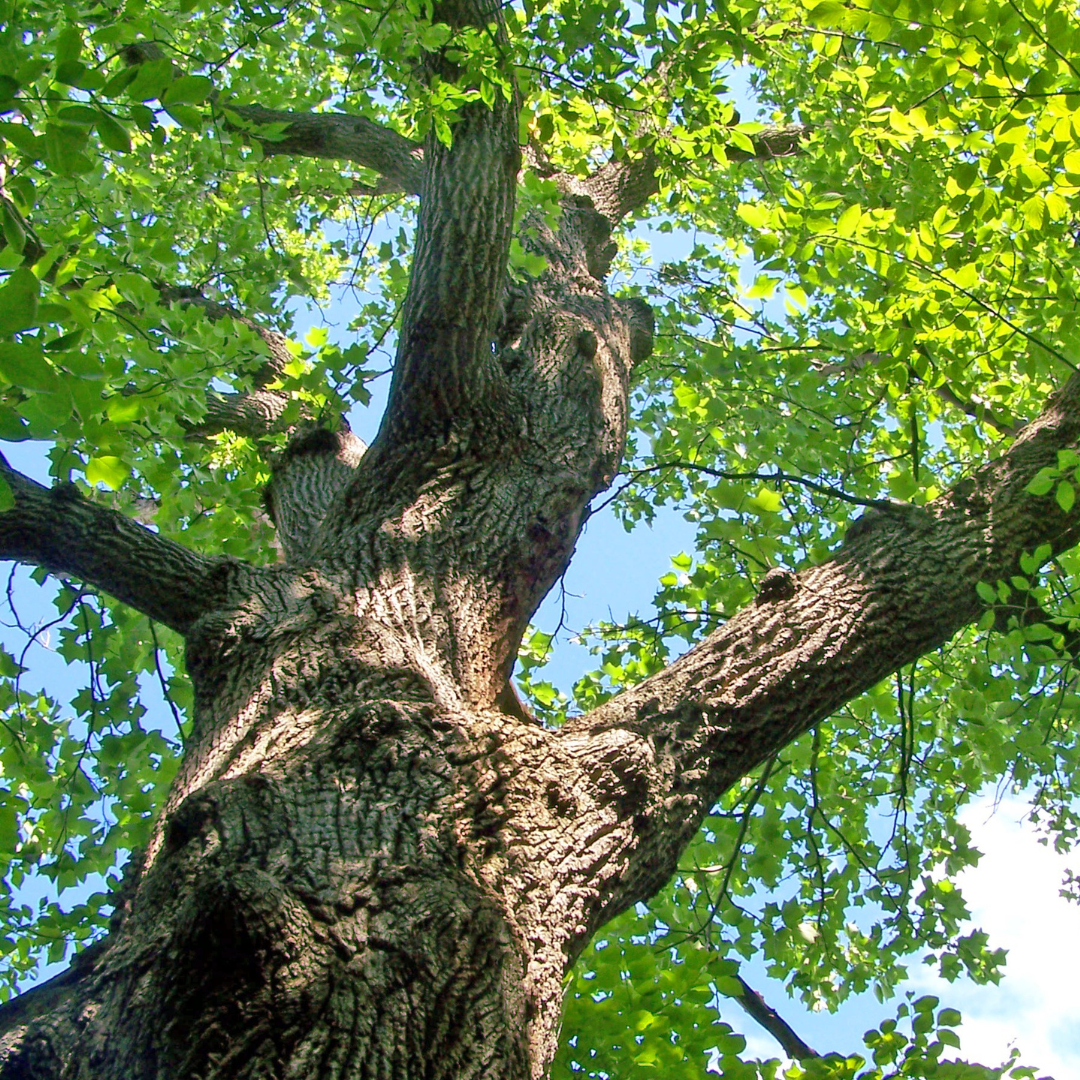
A homeowner can spot many warning signs, but some conditions are difficult to evaluate safely from the ground. Mature oaks and pecans can carry large loads high in the canopy, and internal decay may not be obvious from the outside.
A tree health assessment in Burleson, TX, Granbury, Cleburne, or Midlothian makes sense when the tree has been through severe weather, has developed new symptoms, or sits close enough to a home, driveway, fence, road, or other target that failure would create a meaningful problem.
That is where
tree health care in Cleburne, TX and surrounding North Texas communities becomes a decision process rather than a one-service recommendation.
There is no responsible flat price for tree service in Granbury, TX because weather-related tree work can range from a simple pruning visit to a complex removal involving rigging, heavy equipment, nearby structures, difficult access, or emergency response.
What Changes Tree Service Cost?.

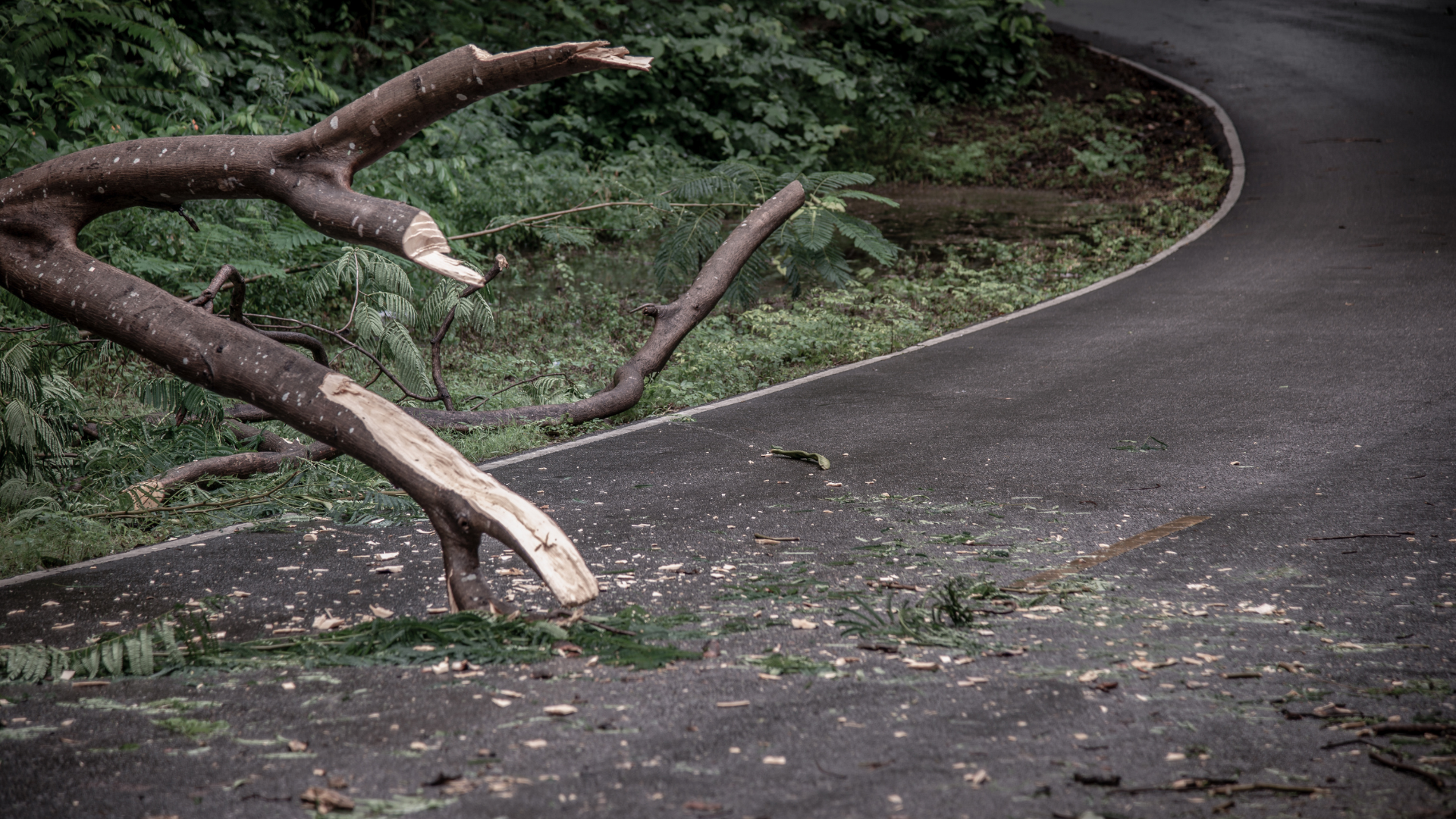
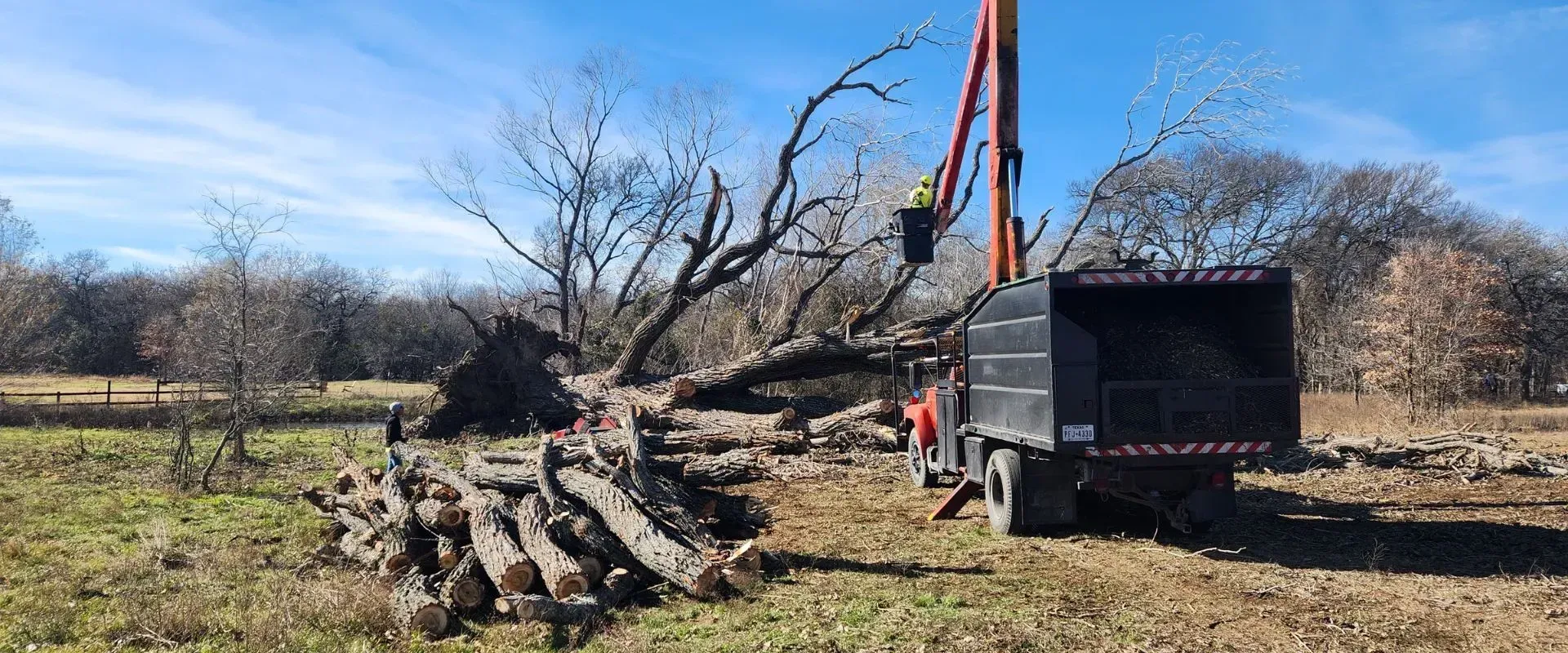
A North Texas storm can leave a tree looking dramatically different within minutes. One large limb may be on the ground, smaller branches may be hanging in the canopy, or the entire tree may have shifted at the roots. The visible debris creates urgency, but it does not always reveal whether the tree can recover.
The choice between
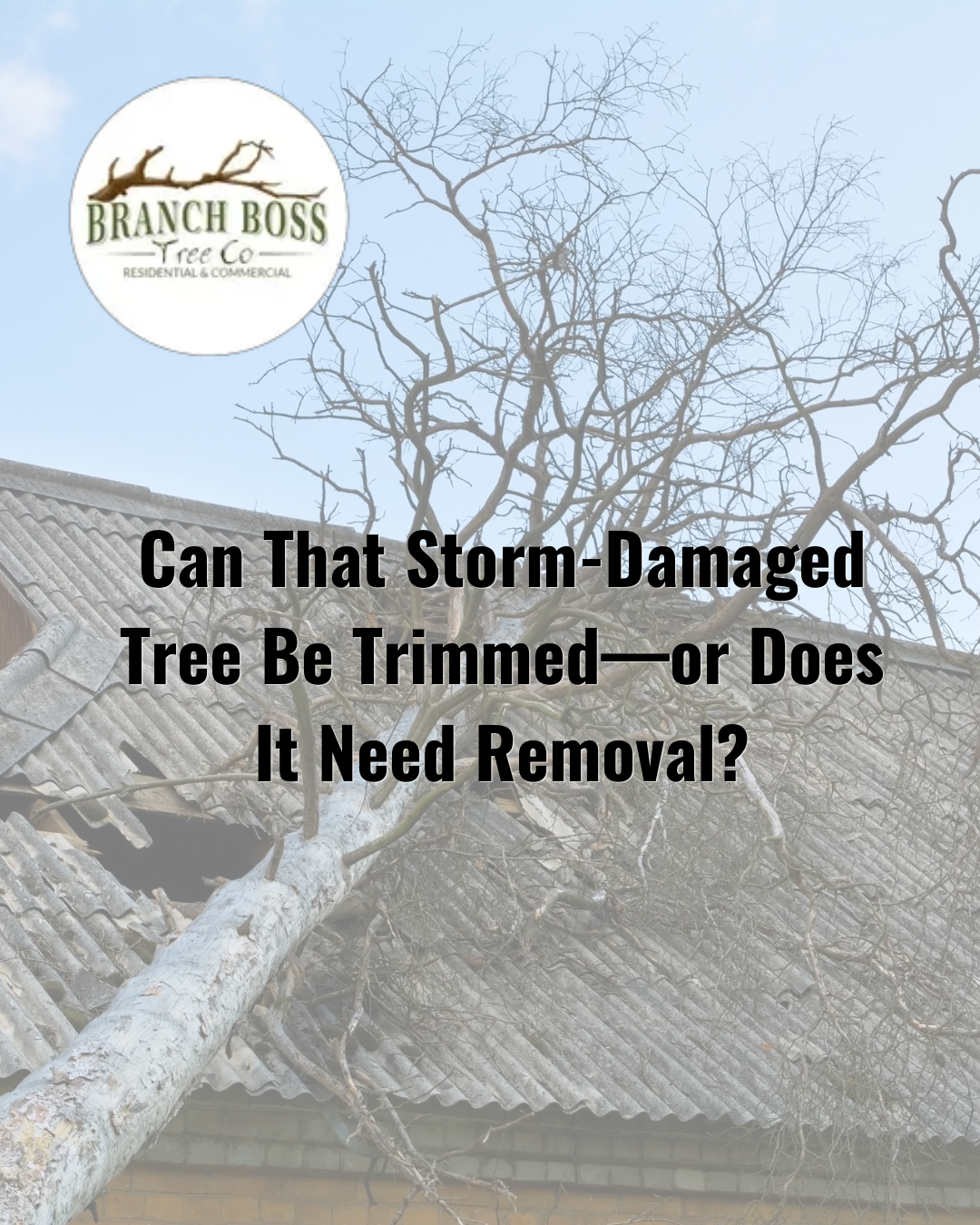
tree trimming vs tree removal depends on where the damage occurred and what remains structurally sound. Trimming may preserve a tree when the problem is limited to repairable limbs. Removal becomes more likely when the trunk, major unions, or root system can no longer support the tree safely. A ground-level professional assessment is the safest way to separate those outcomes.

Why Storm Damage Creates a Different Tree-Care Decision
Routine pruning begins with a generally stable tree. Storm work begins with uncertainty. Wind can twist branches, open cracks at unions, and place wood under tension. Rain-softened soil can also allow the root plate to move. A tree may still be standing while broken tree branches remain suspended above a driveway, roof, walkway, or yard.
This is a practical concern across Granbury and surrounding North Texas communities. The National Weather Service's 2026 North Texas storm summary documents multiple severe-weather events involving wind damage, large hail, and tornadoes. After weather like that, the question is not simply how much debris needs to be removed. It is whether the remaining tree still has a dependable structure.
The transition from September into October is a useful time to revisit trees that were damaged earlier in the year or weakened by summer stress. Changes in canopy density, progressive dieback, new cracks, or movement at the soil line may be more noticeable. Delayed symptoms deserve attention even when the first cleanup is complete.
The same principle applies in Burleson, Benbrook, and Fort Worth. Property layout, species, soil moisture, previous pruning, and the location of nearby targets all affect the recommendation. City name alone does not decide whether trimming or removal is appropriate.
Tree Trimming vs Tree Removal: What Is the Difference?
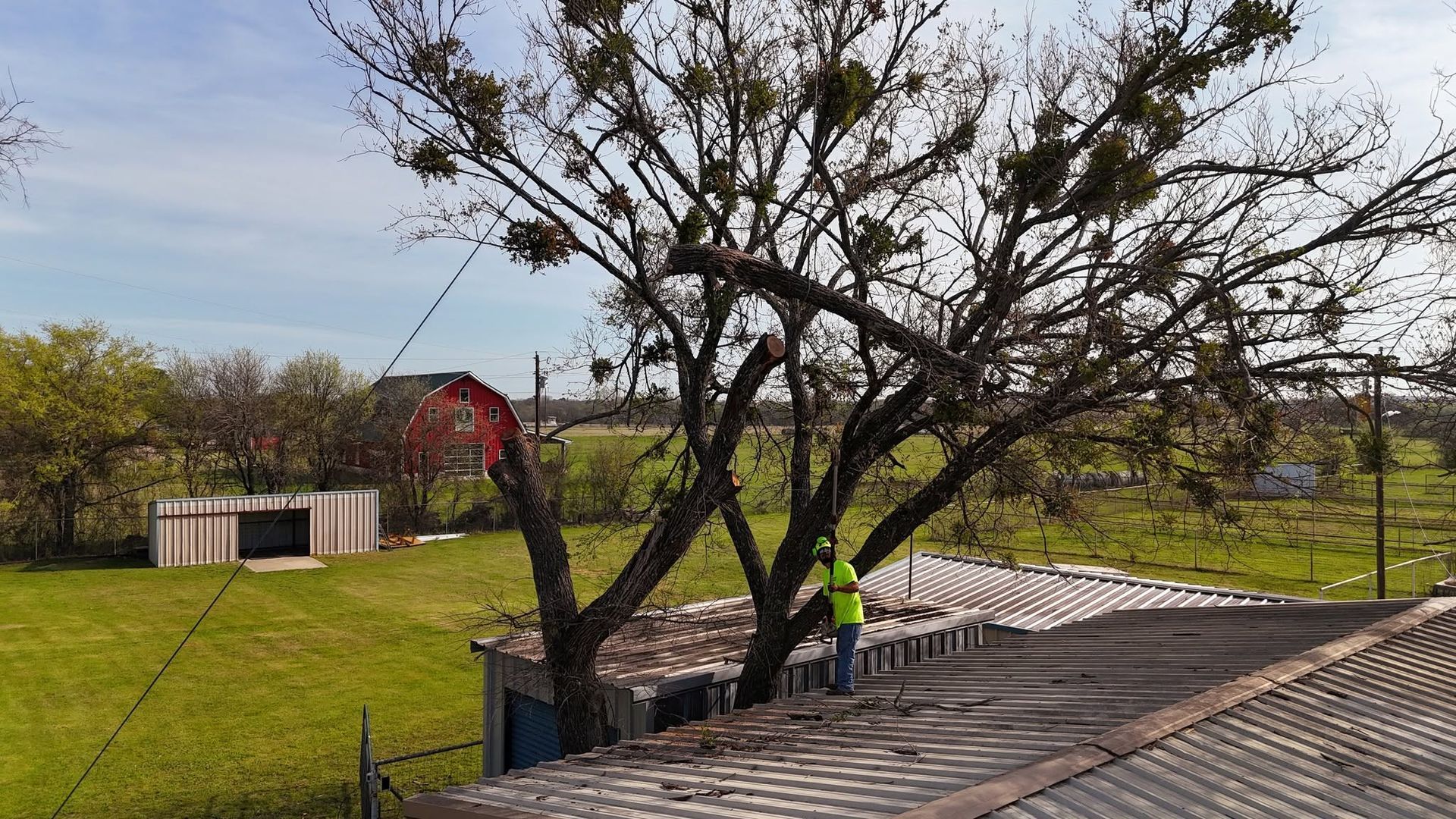
Tree trimming after a storm is selective. The goal is to remove damaged, dead, hanging, or poorly attached branches while preserving a stable trunk, viable canopy, and functioning root system. Good pruning also restores clean branch ends without stripping the tree of more living tissue than necessary.
Tree removal addresses failure at the whole-tree level. The crew dismantles or fells the tree because its remaining structure presents an unacceptable risk, recovery is not realistic, or the tree has already fallen. Removal planning must account for lean, loaded wood, structures, access, utilities, rigging, debris, and whether stump grinding is included.
| Decision point | Tree trimming | Tree removal |
|---|---|---|
| Main purpose | Remove specific damaged or hazardous limbs | Eliminate an unstable, failed, or nonrecoverable tree |
| Best fit | Sound trunk and roots with localized canopy damage | Split trunk, failed root plate, severe lean, collapse, or widespread structural failure |
| What remains | The tree stays and is monitored for recovery | The tree is dismantled or felled and removed |
| Immediate priority | Secure hanging or broken branches | Control the entire tree and its load path |
| Follow-up | Monitor wounds, canopy response, and new defects | Decide on stump work, site restoration, and replacement planting |
| Cost drivers | Height, branch size, access, location, equipment, debris | Tree size, condition, lean, targets, access, rigging, urgency, stump scope |
For homeowners comparing
tree trimming vs tree removal, the key question is not how alarming the fallen branch looks. It is whether the damage is limb-specific or affects the systems that keep the entire tree standing.

Start With Safety Before Inspecting the Damage
Do not walk beneath hanging limbs or climb into a damaged canopy to get a closer look. Storm-loaded branches can move without warning, and a partially uprooted tree can continue shifting after wind has stopped. Keep people, pets, and vehicles away from the drop zone. If a tree or branch is touching a utility line, stay clear and contact the utility provider or emergency services.
The International Society of Arboriculture advises property owners to assess damage, take precautions, resist do-it-yourself storm work, and hire qualified help. Its tree hazard and storm-response guidance explains that wind and rain can soften soil, overturn trees, split wood, and damage utility lines. It also distinguishes pruning defective branches from removing trees with unacceptable risk.
Chainsaw work on storm-damaged wood is especially unpredictable because limbs and trunks can be compressed, stretched, twisted, or supporting hidden weight. Cutting one piece may release another. Ladders add another unstable element beneath a compromised tree. A safe inspection remains on the ground and outside the likely fall path.
Branch Boss offers
24/7 emergency tree services for urgent hazards such as fallen trees, split trunks, dangerous leans, and partially detached branches. If access is blocked or an occupied structure is threatened, treat the situation as hazard control first and a landscaping decision second.
When Tree Trimming May Be Enough
Trimming may be the right response when the storm damage is confined to branches and the trunk, major unions, and root plate remain stable. A mature tree can sometimes lose several limbs and still retain enough healthy canopy to recover. The correct scope is selective pruning, not an automatic reduction of the entire crown.
Texas A&M AgriLife Extension's storm-damaged tree guidance notes that most trees can recover when damage is not severe. That does not mean every visible injury should be ignored. Torn bark, jagged stubs, cracked attachments, and hanging limbs need evaluation so damaged wood can be removed without creating larger wounds or weakening the remaining structure.
Pruning is more likely to be appropriate when the central trunk is intact, the tree has not developed a new lean, soil is not lifting around the base, and the remaining canopy is reasonably balanced. The assessment should also check whether the broken limb exposed decay inside a union. What looked like a simple wind break may reveal an older structural weakness.
Avoid topping or indiscriminate canopy stripping as a substitute for proper tree trimming. Removing too much live canopy can reduce the tree's ability to produce energy and may encourage weakly attached regrowth.
Preservation works only when the remaining tree is both biologically viable and structurally supportable. Monitoring after the initial pruning is part of that decision.
When Tree Removal Is the Safer Choice
Removal becomes the stronger recommendation when damage extends beyond replaceable branches. A split through the main trunk, movement of the root plate, a new severe lean, extensive internal decay, or failure of a major co-dominant stem can leave the whole tree unstable. In those situations, pruning the visible damage may reduce weight without resolving the primary defect.
The position of the tree also changes the risk. A defect above an occupied home, driveway, public sidewalk, neighboring property, or frequently used yard deserves more urgency than the same defect in an isolated area. The ISA describes tree risk in relation to both the likelihood of failure and what could be struck. Sometimes moving a vehicle or outdoor furniture reduces short-term exposure, but a house or utility line cannot simply be relocated.
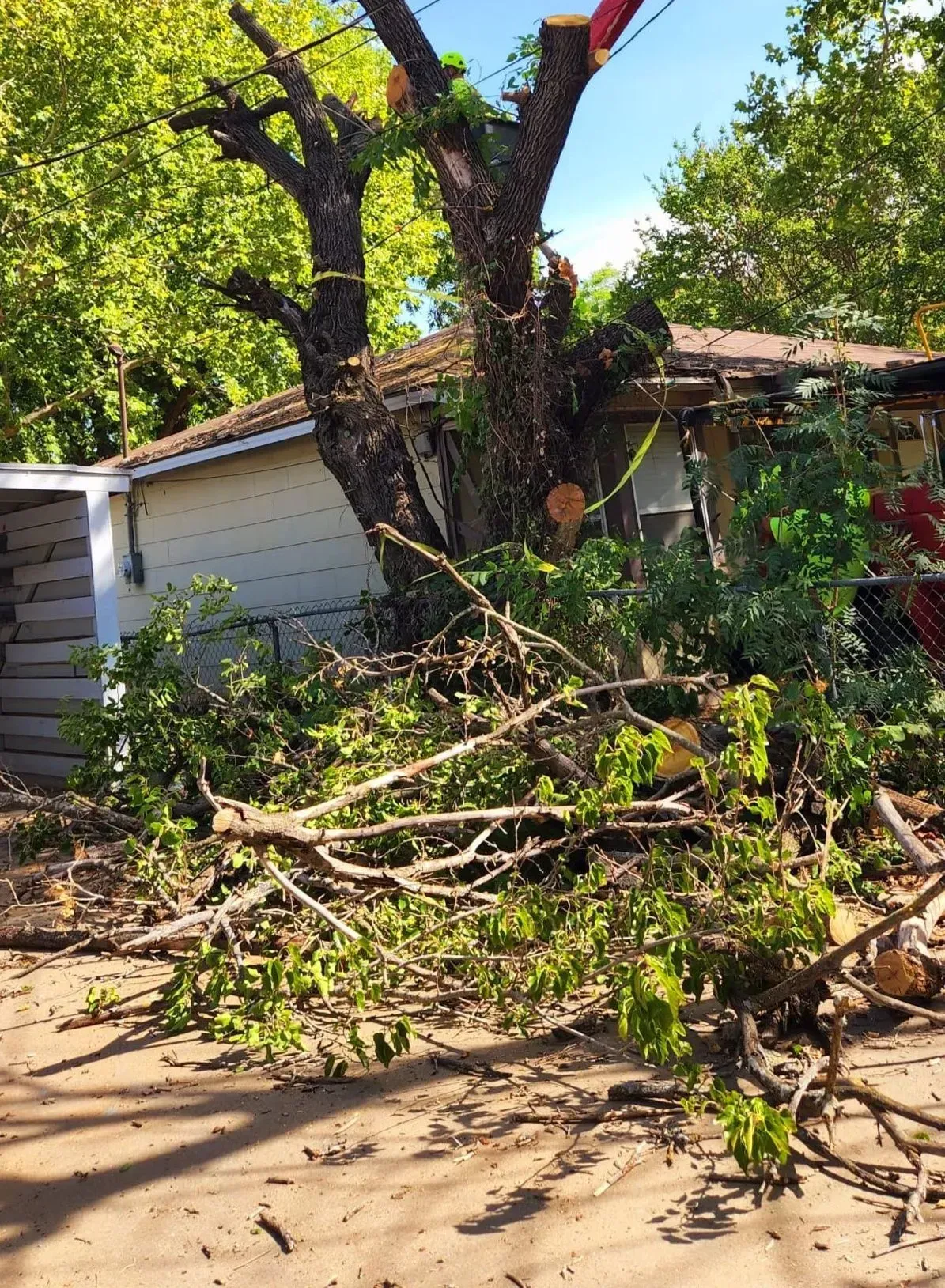
Hazardous tree removal may also be appropriate when a tree has already fallen onto a structure, is hung in another tree, or blocks necessary access. These projects often require controlled dismantling and rigging rather than a simple cut at the base. A tree can appear motionless while its wood remains under substantial load.
Removal should still follow an assessment, not a reaction to appearance alone. The
ISA's homeowner guidance explains that pruning or removing storm-damaged trees can be dangerous and that professional evaluation can help reduce further risk to people and property. The purpose is to choose the least extensive action that brings risk to an acceptable level.
The Damage Pattern Matters More Than the Fallen Debris
Two yards can contain the same volume of branches and require different solutions. One tree may have shed peripheral limbs but retained its main structure. Another may have little debris on the ground because a major stem remains attached by a narrow strip of wood. Evaluate the failure pattern, not the size of the cleanup pile.
Broken Limbs With an Intact Trunk
Localized broken tree branches usually begin as a trimming conversation. The assessment should identify hanging wood, torn attachments, crossing branches, and any imbalance created by the loss. Clean pruning cuts may preserve the tree when enough sound canopy and structure remain.
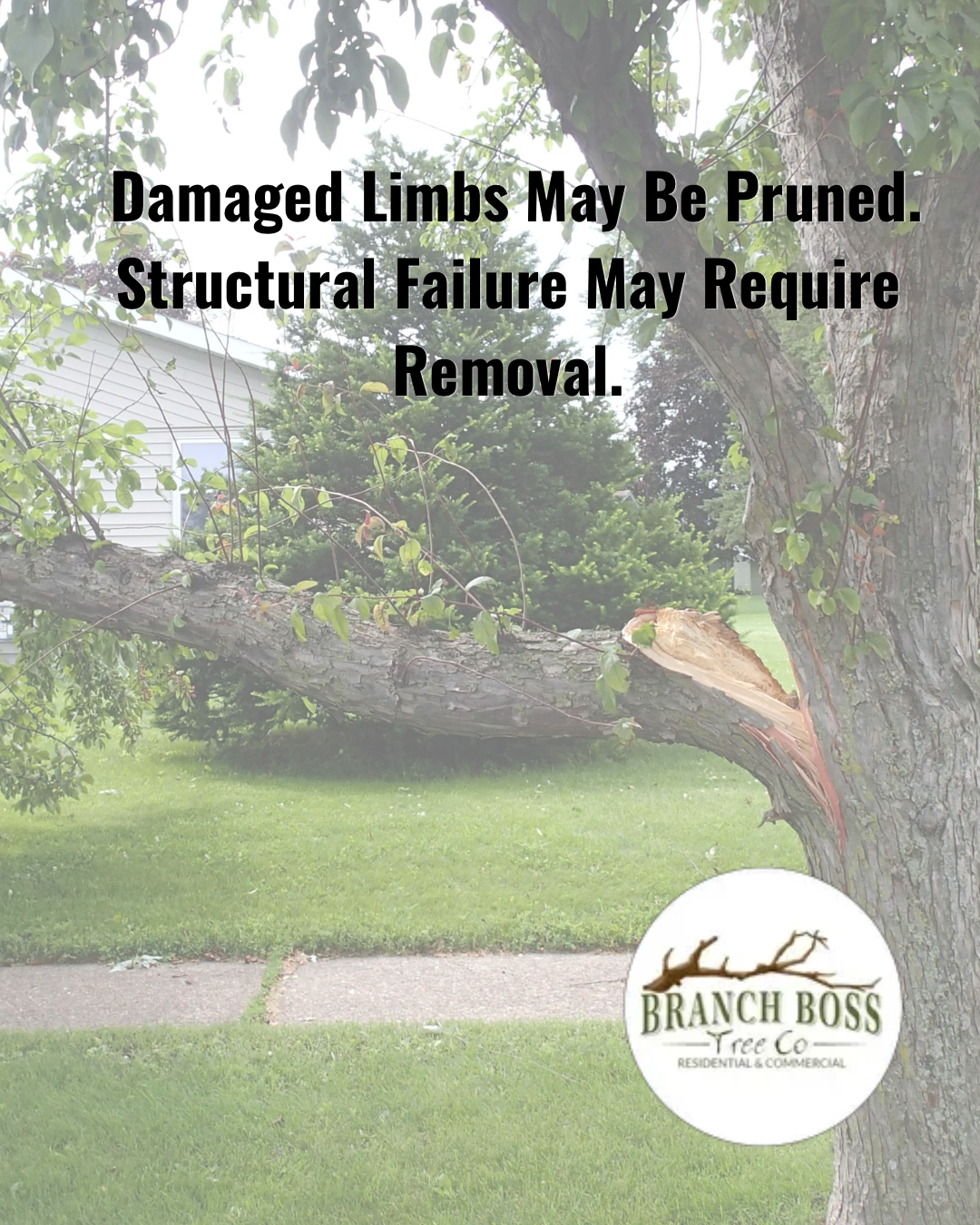
The location of the break matters. Damage near the end of a branch is different from failure at a major union beside the trunk. A large tear can expose internal decay or remove an important structural lead. That may shift the recommendation from one-time pruning to phased restoration, monitoring, or removal.
A Split Trunk or Moving Root Plate
A trunk split or fresh soil lifting around the base points to whole-tree instability. Roots hidden below grade provide anchorage, so visible movement in the root plate is not a cosmetic issue. Saturated clay and strong wind can increase concern when the tree has developed a new lean.
Do not push, pull, cable, or cut a shifted tree as a homeowner repair. Support systems are specialized tools, not guarantees, and they are not appropriate for every defect. When anchorage or the main stem has failed, tree removal may be the practical way to control the hazard.
Damage Near a Home, Road, or Utility Line
The consequence of failure increases when damaged wood hangs over a roof, driveway, street, fence, or occupied area. Even a repairable tree may need immediate branch removal to reopen safe access. Work near electrical conductors belongs with the utility and properly qualified professionals.
Granbury lakeside slopes can complicate equipment positioning, while tighter residential lots in Burleson, Benbrook, and Fort Worth may leave limited drop space. Those site conditions affect rigging and access, but they do not automatically require whole-tree removal. The assessment should separate
tree condition from
work complexity.

What Homeowners Should Document Before Calling
Documentation helps a tree professional understand what changed and plan a safer visit. Take photos only from a stable, protected location. Do not step under the canopy, cross a utility hazard, or move branches just to improve the view.
- Photograph the full tree from several safe angles. Include the trunk, canopy, base, and its position relative to structures.
- Capture the main defect. Record hanging limbs, fresh cracks, torn bark, split unions, soil lifting, and any new lean visible from the ground.
- Note when the damage occurred. Include the storm date, when the change was first noticed, and whether the tree has continued moving or dropping material.
- Record property impacts. Photograph roof, fence, vehicle, driveway, utility, or access damage without entering an unsafe area.
- Mark normal access conditions. Tell the estimator about gates, slopes, septic components, irrigation, shoreline terrain, and tight side yards.
- Keep earlier photos if available. A pre-storm image can show whether a lean, crack, sparse canopy, or root condition is new.
- Confirm the desired cleanup scope. Ask whether debris hauling, wood cutting, stump grinding, and site restoration are included in the estimate.
Share the information with your tree service and, when property damage may involve a claim, follow your insurer's documentation instructions. Photos support communication, but they do not replace an on-site structural assessment.
What Storm-Damage Trimming and Removal Cost
Branch Boss provides a free assessment and quote because storm work cannot be priced accurately from tree height alone. We evaluate the actual defect, tree position, access, rigging needs, nearby targets, debris, urgency, and equipment requirements. A damaged tree leaning over a roof is a different scope from a healthy tree with one accessible broken limb.
Estimated 2026 Market Context
These national residential figures are
external planning benchmarks, not Branch Boss pricing or a Granbury project quote. Storm urgency, unstable wood, utilities, limited access, and structure contact can move a project outside an ordinary range.
| Service benchmark | National market context | What can change the quote |
|---|---|---|
| Tree trimming | $400 to $900 per tree average | HomeGuide's 2026 trimming guide identifies height, health, access, location, equipment, and storm urgency as factors. |
| Tree removal | $400 to $1,200 average | HomeGuide's 2026 removal guide reports a broader $200 to $3,000 span for small accessible trees through large, complex work. |
| Branch Boss assessment | Free assessment and property-specific quote | Damage pattern, lean, root movement, structures, rigging, access, emergency timing, hauling, and stump scope are reviewed on site. |
Compare written scopes, not just totals. A trimming quote should identify which limbs or canopy areas are addressed and what cleanup is included. A removal quote should state whether hauling and stump grinding are part of the price.
The same tree can generate different totals when the included work is different.

Frequently Asked Questions
Can a storm damaged tree recover after losing branches?
Yes, some trees recover when damage is limited and the trunk, roots, and enough healthy canopy remain intact. Recovery depends on species, age, prior condition, wound location, canopy balance, and follow-up care. A professional assessment can identify whether selective pruning and monitoring are reasonable.
Is tree trimming always cheaper than tree removal?
Not in every case. Trimming is usually less extensive, but height, hanging limbs, restricted access, rigging, and utility proximity can make it complex. Price should not determine the treatment before structural condition is understood. The safer appropriate scope should come first.
Does a split trunk always require hazardous tree removal?
A fresh split in the main trunk or a major union is a serious structural defect, but the recommendation depends on its location, depth, tree condition, and targets. Do not enter the fall zone or try to bind the split yourself. Arrange a prompt on-site assessment.
Should I remove broken branches myself after a storm?
Small debris already on the ground may be manageable when no electrical or overhead hazard exists. Hanging limbs, chainsaw work, ladders, trees under tension, and any work near utility lines should be left to qualified professionals. Establish a safe boundary while waiting for help.
How quickly should a storm-damaged tree be inspected?
Immediate hazards need immediate attention, especially trees on structures, blocked access, contact with utilities, root movement, severe lean, or hanging branches over occupied areas. Less urgent damage should still be checked before people resume normal use beneath the canopy.
Does Branch Boss serve areas outside Granbury?
Yes. Branch Boss provides tree trimming, tree removal, and emergency tree services across Granbury and surrounding communities, including Burleson, Benbrook, and Fort Worth. Service availability and the appropriate response are confirmed for the specific property.
Make the Decision From a Ground-Level Assessment
The right answer to tree trimming vs tree removal comes from the remaining structure, not the amount of debris. Choose trimming when damage is confined to branches and the tree can be preserved safely. Choose removal when the trunk, roots, or overall structure can no longer provide dependable support. When the condition is uncertain, keep the area clear until it is assessed.
Branch Boss Tree Co. provides free assessments, professional tree trimming, tree removal, and 24/7 emergency response across Granbury and nearby North Texas communities. Call (817) 487-8448 or request an assessment so our team can evaluate the damage and recommend an appropriate scope.
Tree Trimming and Property Maintenance
Storm Damage Tree Cleanup in Granbury
Don’t wait for the next storm to test your trees.
👉 Worried about a tree near your roof, driveway, or power lines?
Contact Branch Boss Tree Co. today to schedule your summer tree assessment and get expert trimming
that protects your property and peace of mind.
Call us today at
817-487-8448 to let us handle your tree and tree stump removal needs with professionalism and care.