Storm Damage Tree Cleanup in Granbury TX: What to Do After a Severe Weather Event
The storm is over. Now comes the part that catches most Granbury homeowners off guard — figuring out what to do next. Some of what's on your property is cleanup you can handle yourself. Some of it is a hazard that shouldn't be approached without professional assessment. And some of the most dangerous damage isn't visible at all from the ground. Hood County's combination of clay soil root systems, severe thunderstorm patterns, and ice event vulnerability creates storm damage that ranges from cosmetic debris to trees that are structurally compromised in ways that won't become obvious for weeks. Branch Boss provides emergency tree service and storm damage cleanup throughout Granbury, Cleburne, Burleson, and surrounding North Texas. This guide tells you exactly what to do — and what not to do — in the hours and days after a severe weather event.
The First 30 Minutes After a Storm — What to Do and What to Avoid
The first decisions after a storm are safety decisions — not cleanup decisions:
Downed power lines — stop completely
Every downed wire should be treated as energized regardless of appearance. Stay at least 30 feet away from any downed line and anything in contact with it — including trees, branches, fences, and vehicles. Call 911 and your utility company before any assessment or cleanup begins in that area. Do not approach a vehicle with a line on or near it.
Hanging limbs — establish a safe zone
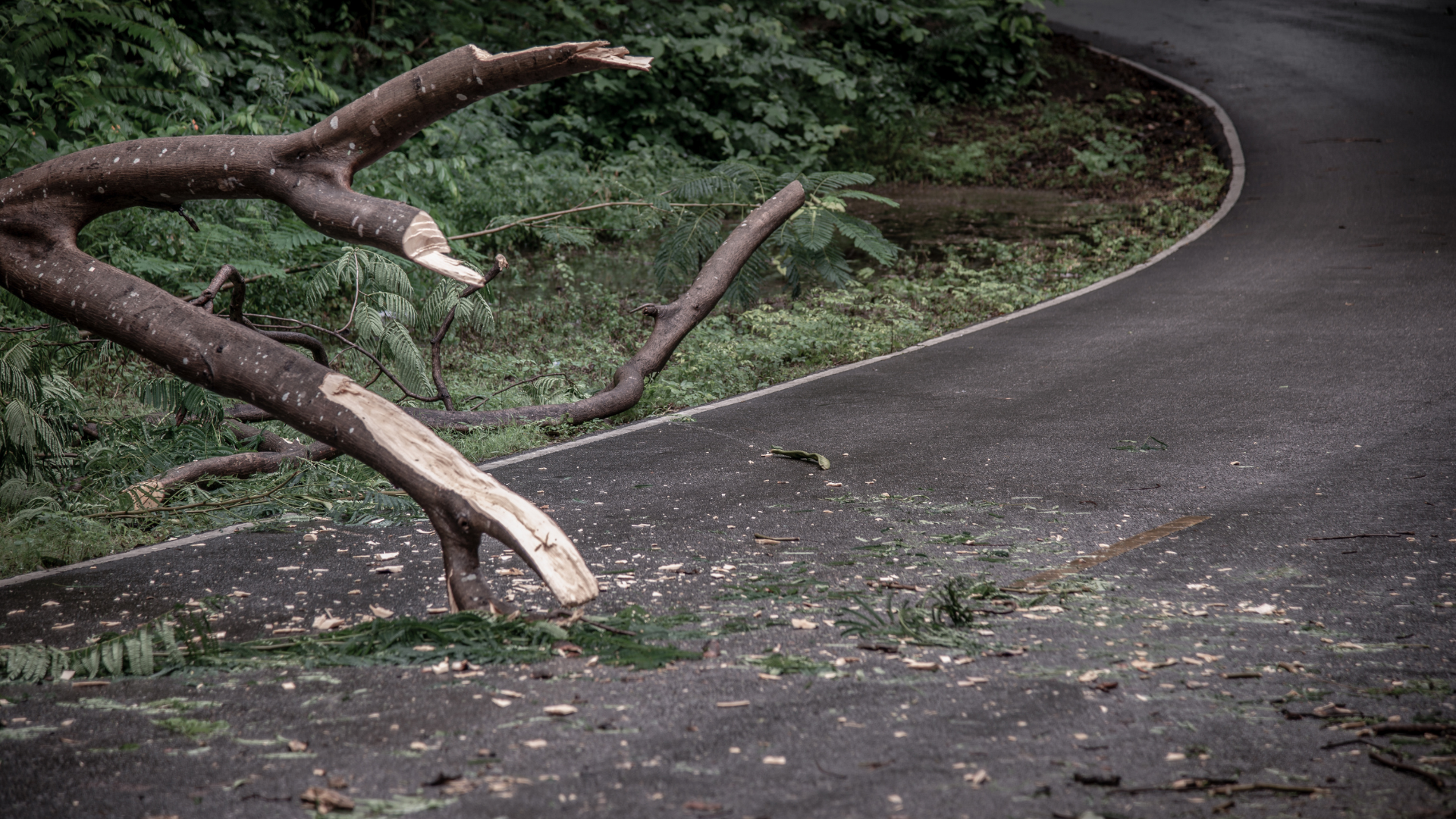
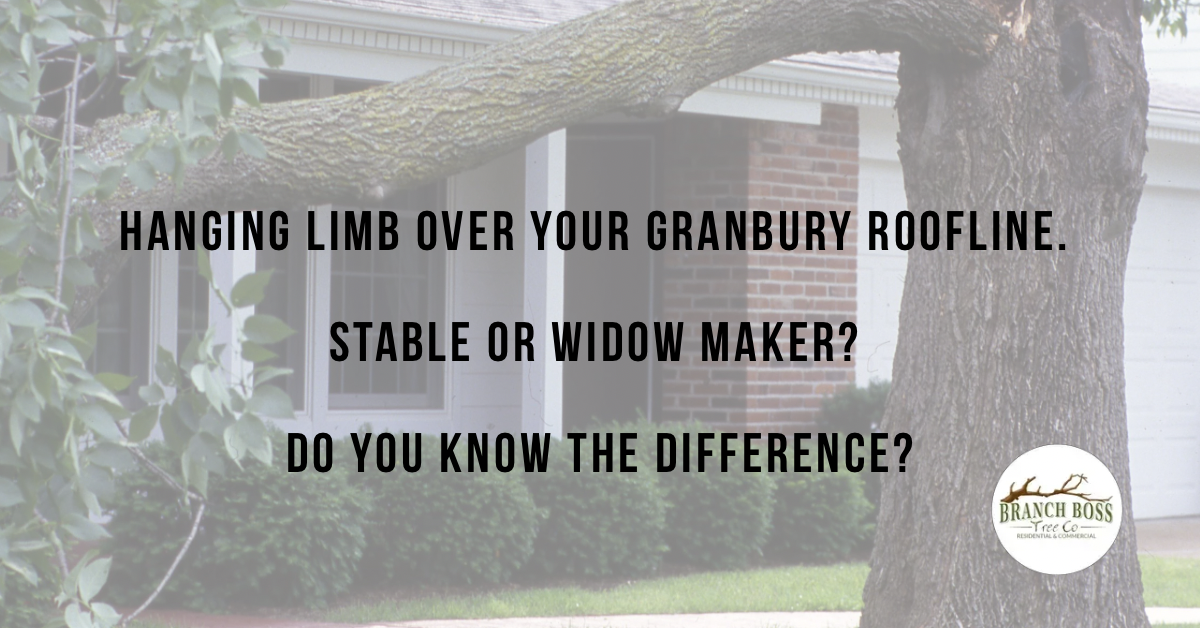
Partially broken branches still suspended in the canopy are called widow makers for a reason. They can fall without warning, without wind, and without any additional disturbance. Mark a 25-foot safety perimeter around any hanging limb with cones, caution tape, or a physical barrier. Keep children and pets completely away from the area until the limb has been professionally removed.
Leaning trees and root heaving — do not approach from the lean side
A tree that has shifted position during the storm — or where soil is mounding or lifting at the base — has a compromised root system that may fail without warning. A 10-degree lean that wasn't there before the storm is a serious structural concern. Approach assessment only from the opposite side of the lean and maintain distance.
What to do in the first 30 minutes:
☐ Confirm all household members and pets are away from the affected areas
☐ Identify any downed lines and call the utility company
☐ Locate hanging limbs and establish safety perimeters
☐ Assess from a distance using binoculars — do not walk under damaged canopy
☐ Begin photo and video documentation of all visible damage from safe positions
☐ Do not start any cleanup until the safety assessment is complete
What to avoid:
- Do not attempt to move branches or trees in contact with power lines under any circumstances
- Do not walk under broken or hanging limbs
- Do not attempt chainsaw work if you are not trained — more injuries happen in storm aftermath than during storms themselves
- Do not assume a leaning tree is stable enough to work around
How to Assess Storm Damage on Your Granbury Property
Once safety hazards are identified and controlled — a systematic walk-around assessment tells you what requires immediate professional response and what can wait:
Immediate hazard — call Branch Boss today:
Root heaving or soil mounding Soil lifting or cracking at the base of the tree, or a depressed area on the opposite side, indicates root system failure. This tree is structurally unstable and should be considered a falling hazard until professionally assessed. This is the highest urgency finding in any post-storm inspection.
Trunk cracks — especially vertical or spiral Deep vertical splits or spiral cracks that weren't present before the storm indicate the tree's structural integrity has been compromised. Horizontal cracks across the grain are rare and indicate imminent failure risk. These trees should not be approached from the direction of potential fall.
Hanging or partially broken limbs Any limb still attached but visibly fractured — regardless of size — is an unpredictable hazard. Don't wait for it to fall on its own.
New lean on a previously upright tree A tree that has shifted position during the storm has experienced root system movement. The degree of lean doesn't determine the urgency — any new lean does.
Moderate urgency — assess within 1 to 2 days:
Major branch failures (over 2 inches diameter) Branches that have snapped but are fully separated and on the ground — away from structures and not hanging — are not immediate hazards but should be pruned back to the trunk correctly to prevent decay spreading to the main wood.
Significant bark loss or wounds Large sections of stripped bark expose the cambium layer to pathogens and insects. These wounds should be assessed and documented but don't require same-day response unless accompanied by structural concerns.
Low urgency — monitor over the following weeks:
Small branch damage (under 2 inches) Twigs and small branches that have fully separated can be cleaned up at your convenience. These don't represent structural or hazard concerns.
Leaf loss Deciduous trees losing a portion of their canopy from storm impact can often recover fully if the trunk and main branch structure is intact.
The walk-around inspection sequence:
- Look UP first — check the full canopy for widow makers, split crotches, and hanging sections
- Look DOWN — soil mounding, cracking, exposed roots
- Check the trunk — vertical cracks, spiral stress marks, bark separation
- Evaluate canopy volume — a tree that has lost less than 50% of its canopy has a reasonable recovery prognosis if structural integrity is intact
Storm Damage You Can Clean Up Yourself — And What Requires a Professional
This is the most practically important distinction for Granbury homeowners after a storm:
What homeowners can safely handle:
✅ Gathering and removing small branches, twigs, and leaves from the yard ✅ Removing broken branches under 2 inches diameter that have fully separated and are on the ground — away from structures, overhead hazards, and power lines ✅ Clearing pathways and hard surfaces of debris ✅ Documenting damage with photos and video for insurance purposes ✅ Placing tarps on accessible roof areas if storm damage is confirmed — from the ground up with a rope, not by accessing a damaged roof
What requires Branch Boss:
🚫 Anything involving power lines — Do not touch, cut, or move any tree or branch in contact with a line. Utility company first, always.
🚫 Hanging limbs at any height — Even small widow makers require professional removal. The unpredictability of partially attached limbs makes them unsafe for homeowners regardless of the branch size.
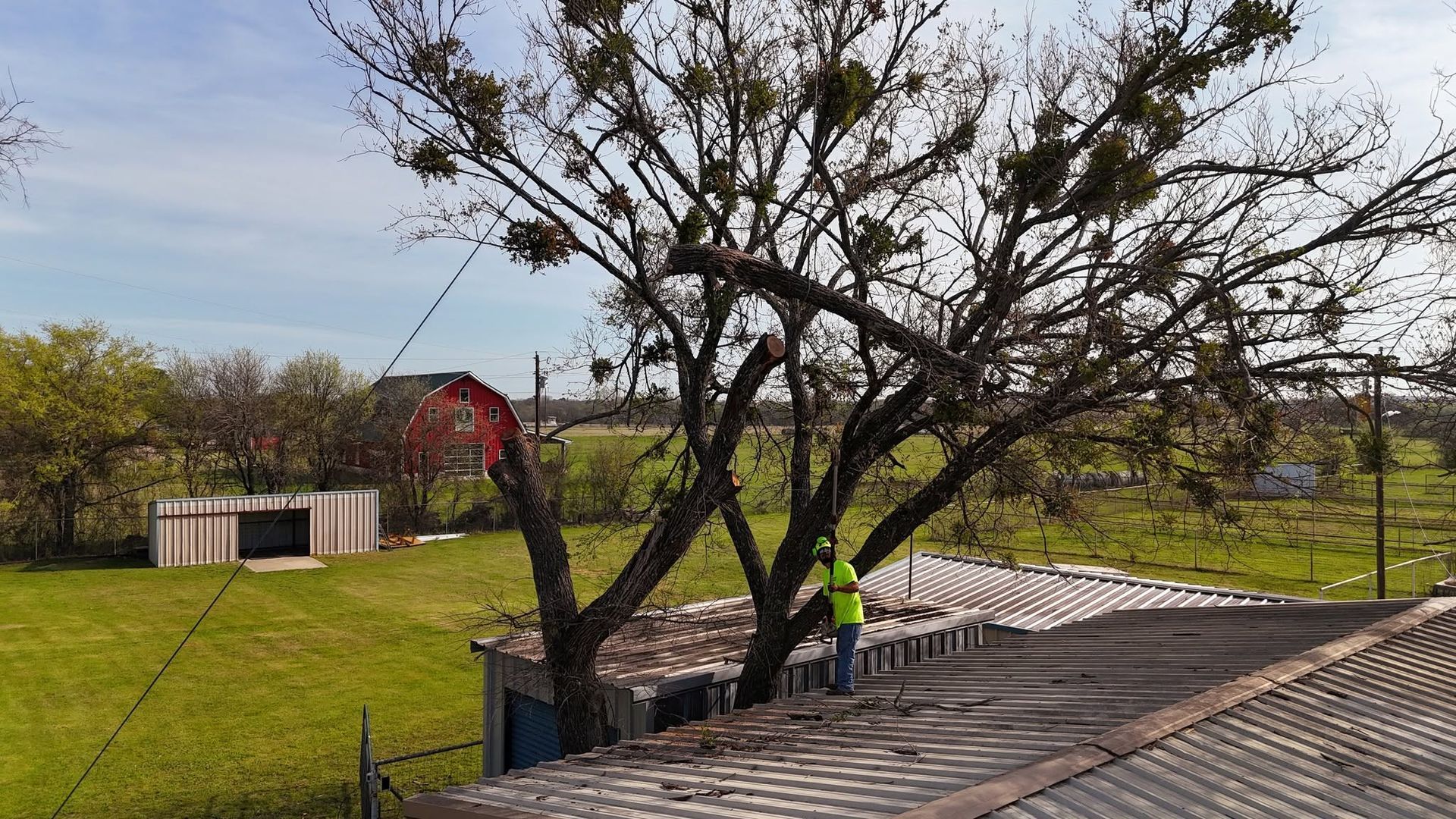
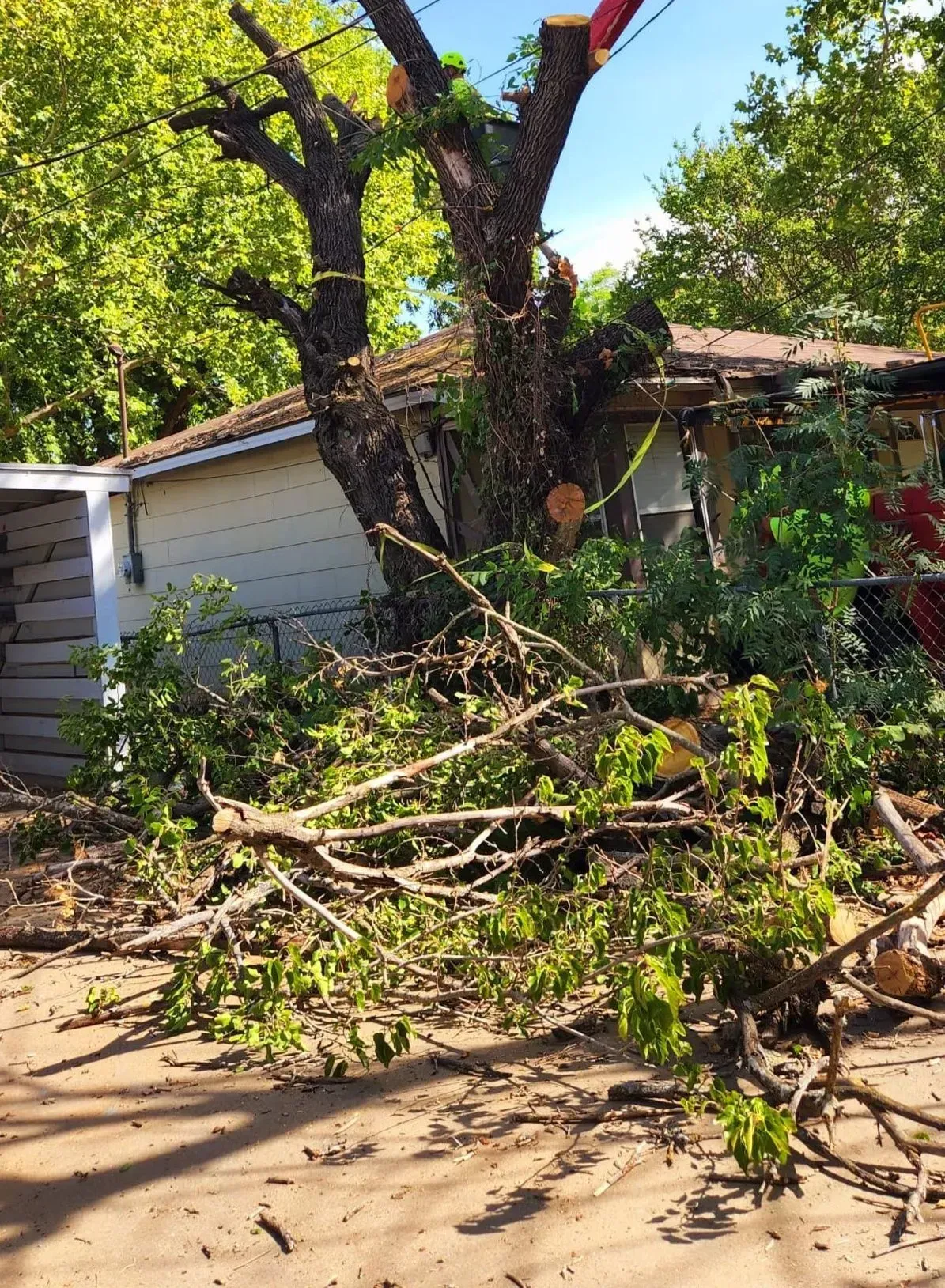
🚫 Trees on structures — A tree or large limb resting on a roof, fence, or vehicle has load dynamics that require rigging and controlled removal. Cutting without understanding the load path creates secondary collapse risk.
🚫 Leaning trees or root heaving — These are structural failures, not cleanup tasks.
🚫 Any chainsaw work near structures or overhead — Chainsaw work on storm-damaged trees involves tension wood — wood under compression or tension from the fall position — that can bind, kick, or release unpredictably. This is one of the leading causes of chainsaw injuries in storm aftermath situations.
The honest chainsaw framework: If you're an experienced chainsaw user — the only safe DIY chainsaw work after a storm is cutting fully fallen wood lying flat on the ground, away from structures, with no limbs under tension. Everything else warrants professional handling.
Why Granbury Trees Are Vulnerable to Storm Damage
Hood County's specific combination of climate patterns and soil conditions creates tree vulnerability that's more pronounced than in most North Texas markets:
Hood County's storm patterns Granbury sits in a corridor that experiences severe thunderstorms with straight-line winds regularly exceeding 65 mph, tornado events, and the ice storm pattern that has produced significant tree damage in recent years. Ice accumulation of as little as a quarter inch is sufficient to snap branches on species that retain foliage through winter — Live Oaks, Southern Magnolias, and Cedars are all common ice failure species in this market.
Clay soil and shallow root systems Granbury's clay-heavy soils restrict oxygen and water infiltration — forcing root systems to grow near the surface rather than developing deep anchor structure. This creates trees that are visually mature and healthy but have fundamentally limited wind resistance compared to trees growing in well-draining soils. The same clay that holds moisture during dry periods also creates root rot conditions during extended wet periods — further weakening the anchor system before any storm arrives.
The drought-to-deluge cycle North Texas weather swings between extended drought and intense rain events. During drought, clay shrinks and cracks — desiccating roots in the gap spaces. When heavy rain follows, the soil expands rapidly — creating unstable conditions for root systems that were already weakened by drought stress. A tree that appears healthy entering storm season may have compromised root integrity from the preceding dry period.
Common failure modes by species in Hood County:
- Live Oak and Red Oak — Ice accumulation causes branch breakage; root compromise from clay-related rot leads to windthrow
- Water Oak — Trunk failure in high wind, particularly in trees with previous decay
- Southern Red Cedar — Snapping or uprooting in straight-line wind events
Any species with included bark V-crotches — The tight V-shaped branch attachments common in many North Texas trees break under ice and wind loading when bark is included in the joint rather than forming a strong collar
The Hidden Damage That Shows Up Weeks After a Storm
This is the category most homeowners miss — and it's where post-storm failures that cause property damage actually originate:
Compromised anchor systems A tree that looks upright and undamaged immediately after a storm may have experienced root system movement that isn't visible for weeks. The signs that develop over the following weeks:
- New lean that wasn't present before — even a slight tilt on a previously vertical tree indicates root failure
- Soil continuing to crack or separate at the base as the root plate settles
- Increasing lean over successive weeks rather than stabilizing
Internal structural stress cracks Extreme wind bends trees past their elastic limit — causing wood fiber separation that isn't visible from the outside. These internal cracks weaken the structural capacity of the trunk without any outward sign. Vertical or spiral cracks that appear on the trunk surface in the weeks following a storm indicate internal stress fractures reaching the outer wood.
Bark wounds as disease entry points Every bark wound, torn limb attachment, and stripped section from the storm is an open door for fungal pathogens and boring insects — particularly in the weeks immediately following the storm before the tree's wound response can wall off the damage. Signs developing over weeks to months:
- Fungal growth appearing at wound sites or the root flare
- Sap leaking from wounds in combination with mushroom growth — indicates internal decay
- Bark separating from the wood in a belt pattern around the trunk
Delayed crown decline A tree that was structurally damaged but hasn't failed visibly may begin showing canopy thinning, dieback from the branch tips inward, or uneven foliage over the 4 to 8 weeks following the storm. This indicates vascular system disruption — water transport is impaired by structural damage that wasn't obvious from the initial assessment.
The post-storm inspection schedule:
- Day 1 — Immediate hazard identification (outlined above)
- Week 2 — Re-inspect all trees that showed any damage for new lean, bark separation, and emerging wound response
- Week 4 — Check for canopy changes — thinning, dieback, or uneven foliage
- Month 2 — Final assessment of any trees with significant bark wounds — look for fungal growth and sap activity
If any new signs appear at the week 2 or week 4 inspection — call Branch Boss for a certified arborist assessment before fall storm season tests the compromised structure again.
Insurance Documentation — What to Do Before Any Cleanup Begins
Documentation done before cleanup protects your claim. Documentation done after cleanup is often insufficient:
The documentation sequence — do this before anything is moved:
- Panoramic property shots — full view of the property from multiple angles showing the context and scope of damage
- Source documentation — photograph the damaged tree or limb from multiple angles before it's removed or cut
- Structural damage close-ups — roof, siding, fencing, and any structure the tree contacted
- Interior damage — if the tree or limb penetrated the structure, document interior impacts before any temporary repair
- All debris — photograph debris fields before any cleanup begins
- Video walkthrough — a continuous video walkthrough that captures context the photos don't fully convey
Before you call your insurance company — know this:
✅ What homeowner's insurance typically covers: Damage to structures (house, garage, fencing) caused by a tree falling from wind or ice. Removal costs when the tree has damaged a covered structure.
✅ What it typically doesn't cover: Tree removal when the fallen tree didn't damage a covered structure — even if it's in your yard. Damage from a tree that was visibly dead or diseased before the storm (this may be considered negligence).
✅ Vehicle damage: Covered under comprehensive auto insurance, not homeowner's insurance.
What to do after documenting:
- Call your insurer within 24 to 48 hours to report the claim and get in the queue
- Make emergency temporary repairs (tarping, boarding) to prevent further damage — keep every receipt
- Do not discard debris or damaged materials until the adjuster has inspected — unless they represent an active safety hazard
- Maintain a written log of all communications with your insurer and every expense incurred
What Emergency Tree Service From Branch Boss Actually Involves
When you call Branch Boss after a storm in Granbury, here's exactly what happens from the first call to site completion:
Initial call and triage We ask about immediate hazards first — power lines, structures in contact with trees, hanging limbs over access routes. This determines response priority and whether same-day emergency mobilization is warranted vs. next-business-day scheduled service.
On-site certified arborist assessment Every Branch Boss emergency response begins with a full property assessment before any cutting begins. We identify all hazard trees, assess structural integrity on trees that look intact, confirm widow makers, and establish a priority sequence for the work. This assessment is what separates professional tree service from a crew that starts cutting without understanding the full picture.
Hazard mitigation first — always Hanging limbs over structures, access routes, and occupied areas are addressed before any other cleanup work. This is non-negotiable regardless of what else is on the property. The hazard that can hurt someone comes before the debris that just looks bad.
Controlled removal and rigging Storm-damaged trees require a different approach than scheduled removal. Tension wood — wood under compression or tension from the fall position — changes how cuts behave. Our crews understand tension wood dynamics and rig accordingly, controlling where sections land rather than letting physics decide.
Complete debris management All removed material is chipped on-site or hauled, depending on project scope. We leave the property clean — not a pile of debris waiting for another contractor.
Insurance documentation support Branch Boss provides written documentation of damage findings, hazard assessment, and work performed — formatted to support insurance claims. We've worked with Hood County homeowners through the insurance process and understand what adjusters need.
Hidden damage follow-up For trees that showed storm stress but weren't removed — Branch Boss can schedule a 4-week follow-up assessment to evaluate the hidden damage indicators that develop after the initial event.
Serving Granbury, Cleburne, Burleson, and Surrounding North Texas
Branch Boss provides emergency storm damage tree cleanup, hazard assessment, and debris removal throughout Granbury, Cleburne, Burleson, Crowley, Alvarado, Joshua, and surrounding Hood and Johnson County communities.
After a storm, response timing matters. A widow maker over your driveway or a leaning tree against your roofline isn't a problem that waits for a convenient scheduling window.
What every Branch Boss storm response includes:
| Service Component | What It Means After a Storm |
|---|---|
| ISA Certified Arborist assessment | Every property evaluated before any cutting begins |
| Immediate hazard prioritization | Widow makers, leaning trees, and structure contacts addressed first |
| Power line protocol | We coordinate with utility companies — never work near active lines |
| Insurance documentation | Written findings formatted for homeowner claims |
| Tension wood expertise | Storm-damaged trees cut correctly — not just fast |
| Complete debris management | Chipped on-site or hauled — property left clean |
| Hidden damage follow-up | 4-week re-assessment available for structurally questionable trees |
| Full liability and insurance | Your property fully covered throughout the response |
Contact Branch Boss today for your Granbury storm damage assessment.
Don’t wait for the next storm to test your trees.
👉 Worried about a tree near your roof, driveway, or power lines?
Contact Branch Boss Tree Co. today to schedule your summer tree assessment and get expert trimming
that protects your property and peace of mind.
Call us today at
817-487-8448 to let us handle your tree and tree stump removal needs with professionalism and care.