What Is Forestry Mulching and Why North Texas Landowners Are Choosing It Over Traditional Land Clearing
When a landowner in Cleburne, Granbury, or Burleson calls Branch Boss about clearing an overgrown pasture, a brush-choked fence line, or a cedar-covered lot, the first question is almost never "how fast can you start?" It is "what method should I use?"
That question matters more than most landowners realize before they have seen what the wrong clearing method leaves behind. A dozer that pushes through three acres of mixed cedar and brush can get the job done in a day. It can also leave bare, compacted soil vulnerable to erosion before the first rain, remove the topsoil that took decades to develop, and cost significantly more once debris hauling and disposal are factored in.
Forestry mulching is the method Branch Boss recommends for the majority of brush clearing, pasture reclamation, and vegetation management projects across Johnson County. Not because it is newer or because it looks better on a brochure. Because for most North Texas properties, it produces a better result for the land, at a lower total cost, faster.

This guide explains exactly what forestry mulching is, how it compares to traditional clearing across every dimension that matters, when each method is the right call, and what North Texas landowners in Cleburne, Burleson, Granbury, Midlothian, and Joshua need to know before making the decision.

What Forestry Mulching Actually Is
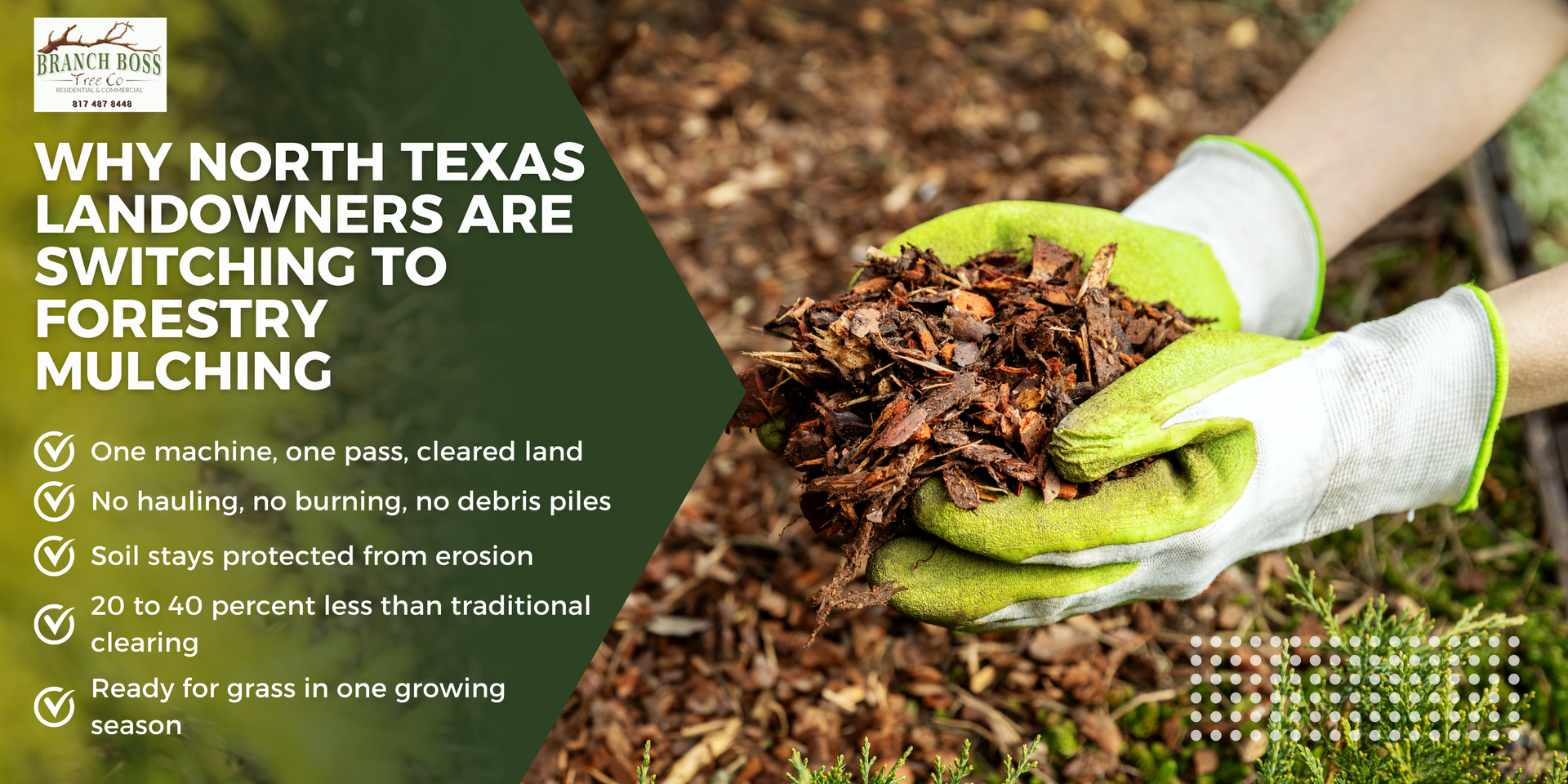
Forestry mulching is a single-machine land clearing method. A track-mounted unit with a rotating drum covered in carbide teeth drives through brush, saplings, small trees, and dense undergrowth and grinds everything into a layer of mulch in one continuous pass. Nothing gets hauled away. Nothing gets burned. The cleared material stays on-site as a layer of organic mulch that protects the soil, slows erosion, and breaks down over one to three years to return nutrients to the ground.
What a forestry mulcher handles on a North Texas property:
- Cedar, mesquite, yaupon, and the invasive brush species common across Johnson County pasture and rangeland
- Dense undergrowth and native brush of any density
- Saplings and small trees up to approximately 8 to 10 inches in diameter at the base
- Overgrown fence lines, hunting trails, and firebreaks
- Lots and acreage being prepared for recreational use, livestock, or sale
What requires additional work before mulching:
- Large timber above approximately 10 to 12 inches diameter, which needs chainsaw crew preparation first
- Sites requiring construction-ready bare soil, which needs traditional clearing and grading
- Stumps from previously felled large trees, which need dedicated stump grinding
Forestry Mulching vs. Traditional Land Clearing: How They Compare
Branch Boss operates both forestry mulching equipment and traditional clearing equipment. The recommendation on any given Johnson County property comes from what the land and the landowner's goals actually require, not from what generates a larger job.
| Category | Forestry Mulching | Traditional Clearing |
|---|---|---|
| Cost | 20 to 40 percent less for most projects per Bear Claw Land Clearing's 2026 Texas data | Higher: multiple machines, labor, debris hauling or burning |
| Speed | 2 to 4 acres per day in typical North Texas brush | Variable: cutting, piling, and disposal are sequential phases |
| Soil condition | Minimal disturbance. Roots stay in ground, preventing erosion | Major disruption. Bare soil exposed to wind and rain |
| Debris management | None. Mulch stays on site as ground cover | Hauling, burning, or piling required |
| Precision | Operator-directed. Selective clearing possible | Limited precision. What is in the machine's path is cleared |
| Burn permits | Not required | Often required for debris burning in Johnson County |
| Result | 2 to 6 inches of mulch covering cleared area | Bare ground ready for grading or construction |
The most consistent thing Branch Boss hears from landowners who have used traditional clearing before switching to mulching is surprise at the soil condition difference. A dozer-cleared site in North Texas during dry summer conditions loses topsoil to wind before the next rain arrives. A mulched site has ground cover the moment the machine finishes its pass.
Why the Mulch Layer Matters for North Texas Properties
The mulch left on-site after forestry mulching is not a byproduct to be managed. It is one of the primary reasons the method produces better long-term land outcomes than traditional clearing.
What the mulch layer does:
- Absorbs rainfall impact and slows runoff, holding Johnson County's clay-heavy topsoil in place
- Suppresses weed and invasive species regrowth by blocking light from reaching the soil surface
- Retains soil moisture during North Texas summer drought conditions
- Decomposes over one to three years, returning organic matter and nutrients to the soil
- Provides immediate ground cover that begins the revegetation process without reseeding
According to
Texas A&M AgriLife Extension's brush management guidance, soil disturbance from mechanical clearing is one of the primary drivers of invasive species reestablishment on cleared land. The mulch layer that forestry mulching leaves behind directly reduces that reestablishment risk by maintaining soil structure and limiting bare ground.
The North Texas Applications Where Forestry Mulching Delivers the Most Value
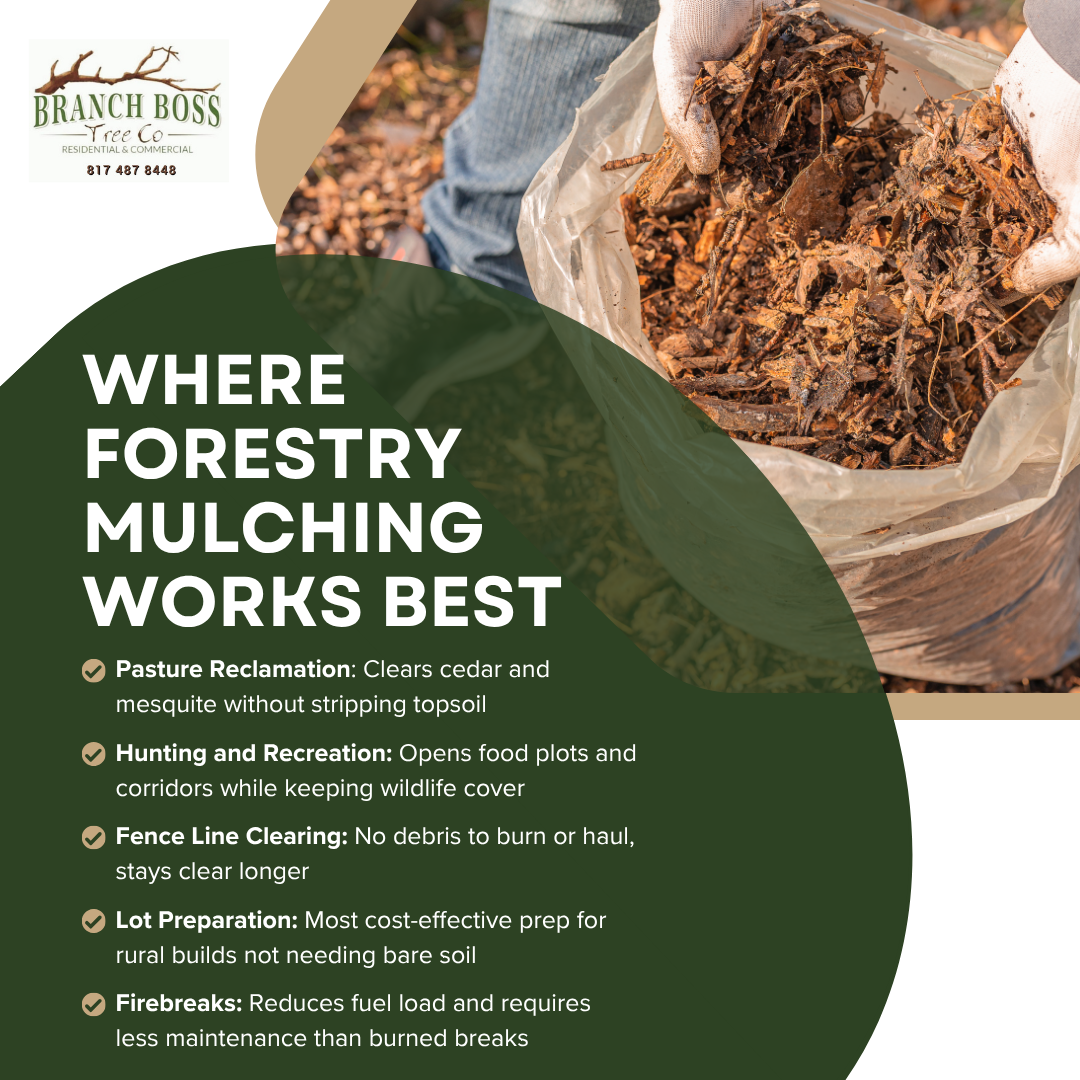
Branch Boss deploys forestry mulching across a range of Johnson County and North Texas projects. These are the applications where the method consistently outperforms traditional alternatives.

When Traditional Land Clearing Is the Right Answer
Branch Boss is direct about this because it matters for making the right decision.
Traditional clearing is the correct method when:
- The project requires construction-ready bare soil for a concrete slab, engineered fill, or foundation
- Large timber has market value and a feller-buncher operation can recover that value to offset clearing cost
- Significant grading and earthwork will follow clearing and both can be accomplished more efficiently by traditional equipment in a single operation
- Vegetation density is so extreme that mulching equipment cannot operate at effective production rates

For the majority of brush clearing, pasture reclamation, fence line work, and recreational land improvement projects across Cleburne, Burleson, Granbury, Midlothian, and Joshua, forestry mulching is the more efficient, more economical, and better-for-the-land approach. For construction preparation on large-scale commercial or residential development sites, traditional clearing is often the right call. The honest answer depends on the property, and Branch Boss assesses both before recommending either.
What to Expect from a Branch Boss Forestry Mulching Visit
Every forestry mulching project with Branch Boss begins with an on-site assessment. The crew evaluates vegetation type and density, terrain, access, the landowner's goals for the property, and whether any large timber requires chainsaw crew preparation before the mulcher can operate efficiently.
| Step | What happens |
|---|---|
| On-site assessment | Vegetation density, terrain, access, and goals evaluated |
| Scope discussion | Clear agreement on what gets cleared and what stays |
| Mulching | Machine covers property in one continuous pass |
| Chip material | Remains on site or is concentrated per landowner preference |
| Final walkthrough | Results reviewed with landowner before crew departs |
Free estimates are available for any land clearing project across Johnson County and the surrounding North Texas communities.
Frequently Asked Questions
How much does forestry mulching cost in North Texas?
Forestry mulching in Texas typically costs $1,500 to $6,000 per acre depending on vegetation density and terrain, according to current Texas land clearing data. Branch Boss provides free on-site estimates with honest pricing before any work is scheduled.
How fast can Branch Boss cover my property?
Most North Texas brush conditions allow coverage of 2 to 4 acres per day. Dense cedar stands or steep terrain may require additional time. The on-site assessment provides a realistic timeline before the project begins.
Will the mulch layer damage my soil or prevent grass from growing?
The opposite. The mulch layer decomposes over one to three years, returning organic matter to the soil and improving moisture retention. Grass establishment typically begins within one growing season on mulched sites.
Does forestry mulching kill cedar permanently?
Mulching removes the above-ground cedar mass and significantly reduces the root system's capacity to resprout. Some species will attempt regrowth from the root system. A follow-up treatment or second pass one to two growing seasons later addresses any regrowth before it reestablishes.
Do I need a burn permit for forestry mulching?
No. Because the vegetation is ground in place and nothing is burned, burn permits are not required. This is one of the practical advantages over traditional clearing methods that involve debris burning.
Can Branch Boss selectively clear my property, leaving certain trees?
Yes. Forestry mulching equipment is operator-directed with precision. The crew can clear understory brush while preserving mature post oaks, shade trees, or any specific vegetation the landowner wants to keep. This selective capability is one of the primary reasons the method is preferred for recreational and wildlife land management.
What is the difference between forestry mulching and stump grinding?
Forestry mulching processes standing brush, saplings, and smaller trees in a single pass. Stump grinding removes existing stumps from previously felled trees. Branch Boss offers both services, and many properties benefit from mulching the standing vegetation followed by stump grinding for any large stumps from trees removed separately.
If you're dealing with cedar overgrowth, brush encroachment, or overgrown acreage in Cleburne, Granbury, Burleson, or the surrounding North Texas area, Branch Boss Tree Co. can evaluate your property and recommend the safest, most practical solution.
Don’t wait for the next storm to test your trees.
👉 Worried about a tree near your roof, driveway, or power lines?
Contact Branch Boss Tree Co. today to schedule your summer tree assessment and get expert trimming
that protects your property and peace of mind.
Call us today at
817-487-8448 to let us handle your tree and tree stump removal needs with professionalism and care.