Black silhouette of a tree with a full canopy.

Why Are Large Tree Branches Falling Without a Storm After a Hot Texas Summer?

September 7, 2026

A homeowner can spot many warning signs, but some conditions are difficult to evaluate safely from the ground. Mature oaks and pecans can carry large loads high in the canopy, and internal decay may not be obvious from the outside.


A tree health assessment in Burleson, TX, Granbury, Cleburne, or Midlothian makes sense when the tree has been through severe weather, has developed new symptoms, or sits close enough to a home, driveway, fence, road, or other target that failure would create a meaningful problem.


That is where tree health care in Cleburne, TX and surrounding North Texas communities becomes a decision process rather than a one-service recommendation.

There is no responsible flat price for tree service in Granbury, TX because weather-related tree work can range from a simple pruning visit to a complex removal involving rigging, heavy equipment, nearby structures, difficult access, or emergency response.


What Changes Tree Service Cost?.
Overgrown wooded trail with a worker in a yellow hard hat and text: “The Damage You Can See Isn’t Always the Damage That Matters.”

A large limb can fall on a calm day even when there has not been a storm.


At Branch Boss Tree Co., we see this most often when a tree has been carrying stress for weeks or months. Heat, drought, old cracks, decay, weak branch unions, heavy end weight, or earlier storm damage can all leave a limb vulnerable.


Sometimes the failure is sudden. Other times, the warning signs were already there but easy to miss from the ground.


For homeowners in Cleburne, Burleson, Granbury, and Joshua, September is a good time to look closely at mature trees after summer heat and before fall winds begin putting additional stress on the canopy.

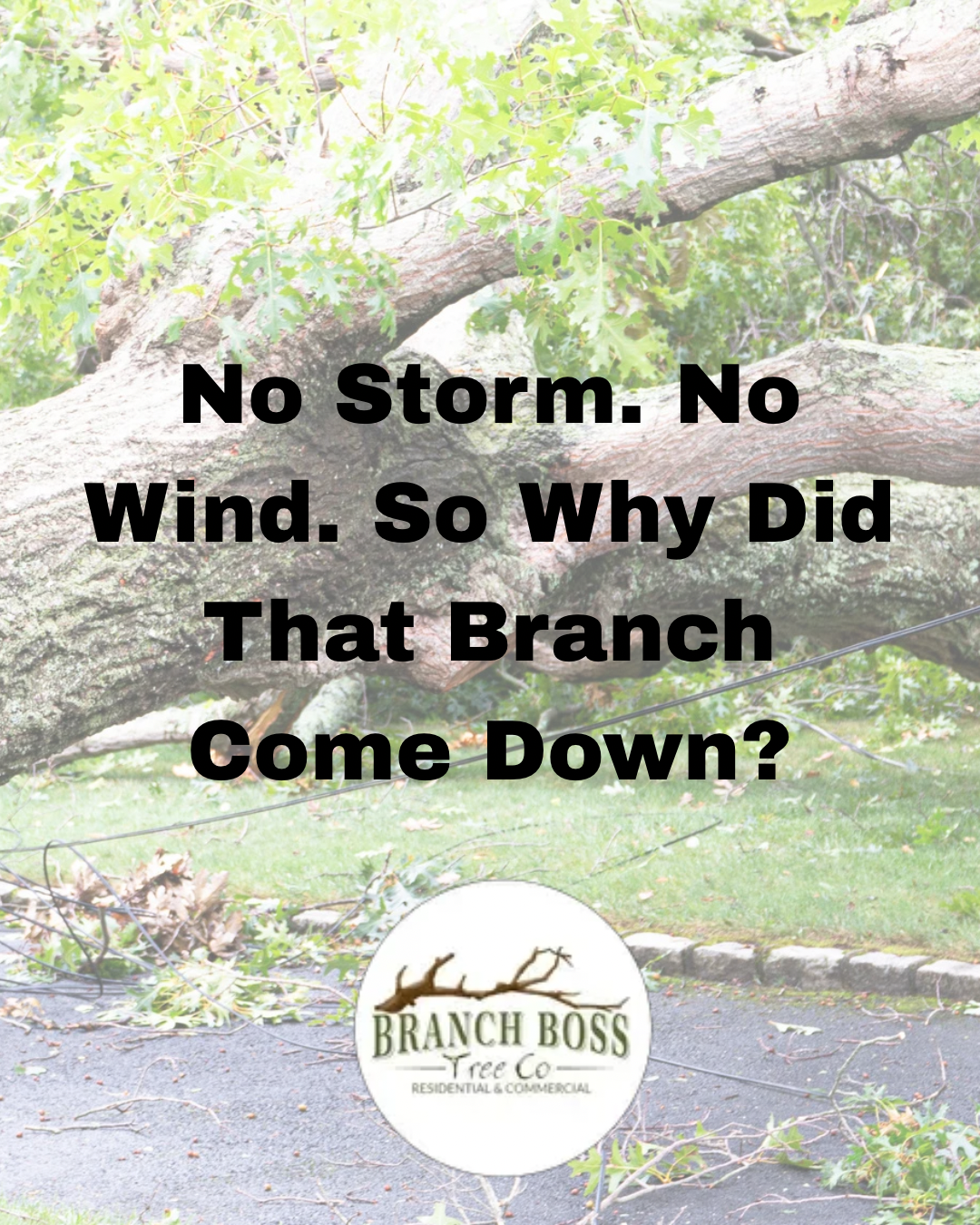
Text over a fallen tree branch: “No Storm. No Wind. So Why Did That Branch Come Down?”

Why September Is a Good Time to Inspect Mature Trees

Cleburne came through another stretch of dangerous late-summer heat.


In late August 2026, the National Weather Service included Cleburne and Johnson County in an Extreme Heat Warning, with heat index values reaching as high as 109°F. National Weather Service Fort Worth


That kind of heat can expose weaknesses in trees that were already under stress.


By September, we are looking for:

  • Large limbs with heavy end weight
  • Dead branches mixed into a green canopy
  • New cracks at major unions
  • Areas of peeling bark
  • Cavities or old wounds
  • One-sided canopy thinning
  • Limbs that have already dropped once this summer
  • Root-zone changes from construction or compaction


A calm day does not make a tree safe if one of those problems is already present.

109°F heat stress graphic with a woman, fan, and potted plant; Branch Boss Tree Co. logo

What Sudden Branch Drop Actually Means

Sudden branch drop describes the unexpected failure of a large living limb during hot, often calm weather.


Extension guidance has documented the phenomenon in mature trees, especially large shade trees with long, heavy branches. The exact mechanism is not fully understood. UC Agriculture and Natural Resources


That is important because homeowners often assume one of two things:

  • The entire tree must be dying
  • Nothing is wrong because there was no storm


Neither assumption is reliable.


A living branch can fail because of internal weakness, excessive weight, old damage, or stress that is not obvious from the ground.


At Branch Boss Tree Co., we treat the fallen limb as a reason to inspect the rest of the tree, not as automatic proof that the whole tree should be removed.

Five Common Reasons Large Limbs Fall Without a Storm

When tree branches are falling for no reason, there is usually a reason worth finding.


1. Heat and Drought Stress

Hot weather increases water demand while dry soil limits what the roots can supply.

The tree may still look green, but the canopy and root system can be under strain.


2. Hidden Decay

A branch can carry leaves even when the wood inside is losing strength.

Old wounds, cavities, fungal activity, and previous damage can all reduce the amount of solid wood supporting a heavy limb.


3. Weak Branch Unions

Two large stems growing from a tight V-shaped union may not have a strong connection.

As the branches get larger and heavier, the union becomes a possible failure point.


4. Heavy, Overextended Limbs

Long horizontal branches place more leverage on the point where they attach to the tree.

That matters even more when the branch carries a lot of foliage or has not been structurally pruned in years.


5. Old Storm Damage

A branch does not always fail during the same storm that weakened it.

A crack from wind, ice, lightning, or earlier impact can remain hidden until the limb finally gives way weeks or months later.

What the Break Can Tell You

After a limb falls, the break itself can offer useful clues.


You do not need to climb the tree to inspect it.


What We Look For

What You See What It May Mean
Dark or hollow wood Internal decay
Fresh wood with little visible rot Possible overload or sudden branch drop
Split running into the trunk Larger structural concern
Failure at a tight union Weak attachment
Old discoloration inside the break Earlier internal damage
Multiple dead branches nearby Broader canopy decline

The most important question is whether similar defects remain elsewhere in the tree.


One fallen limb may be isolated. Several similar limbs with the same shape, weight, or attachment problem deserve more attention.

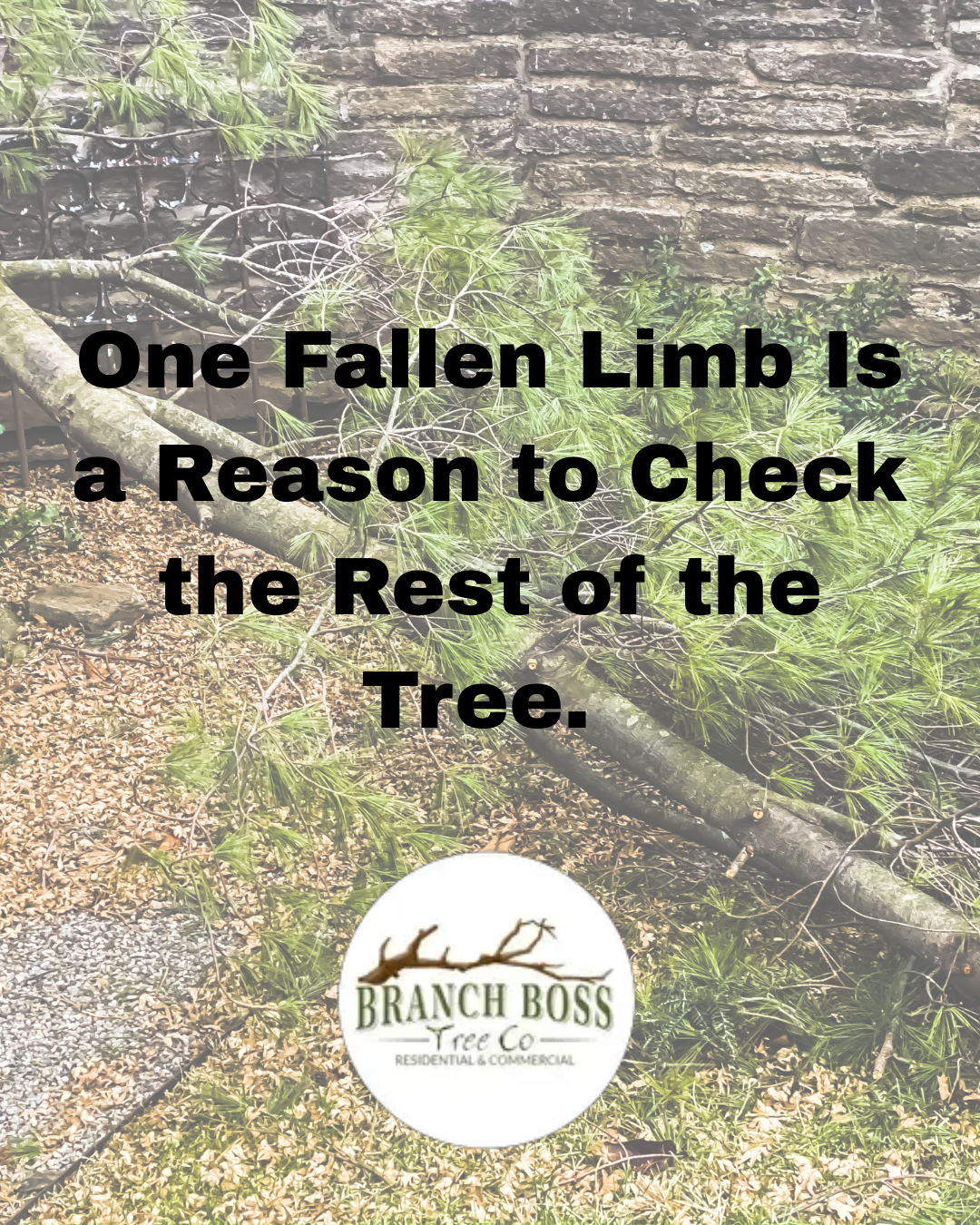
Storm-damaged tree with text: “One fallen limb is a reason to check the rest of the tree.”

Use This 10-Minute Ground Check

You can learn a lot without standing under the canopy.


Look at the Crown

Check for:

  • Hanging branches
  • Large dead limbs
  • Long horizontal limbs with heavy end weight
  • Fresh wounds
  • One side thinning more than the other
  • Broken branches caught in the canopy


Look at the Trunk

Check for:

  • Vertical cracks
  • Splits at major unions
  • Cavities
  • Fungal growth
  • Peeling bark
  • Old wounds getting larger


Look at the Root Zone

Check for:

  • Recent trenching
  • Vehicle compaction
  • Soil piled over roots
  • Exposed roots
  • Soil lifting on one side
  • Major irrigation changes


Do not use watering as a substitute for dealing with a cracked, hanging, or structurally unstable limb.

What to Do After a Large Limb Falls

The first step is keeping the area below the tree clear.


Move people, pets, vehicles, and outdoor furniture away from the canopy until you know whether another limb is unstable.


Do not:

  • Pull on a hanging limb
  • Cut from underneath a partially attached branch
  • Climb the tree to inspect the break
  • Park under the remaining canopy
  • Assume the entire tree must be removed


If a branch is touching a power line, stay away from the tree and surrounding ground and contact the utility or emergency services.


Branch Boss Tree Co. provides 24/7 emergency tree services for hanging limbs, split trees, fallen trees, and immediate hazards.

Can the Tree Be Saved?

Often, yes.


One fallen limb does not automatically mean removal is the right answer.


At Branch Boss Tree Co., we usually think in three categories.


Monitor

Monitoring may make sense when:

  • The rest of the canopy looks healthy
  • No major cracks are present
  • The root system appears stable
  • The branch failure was isolated
  • No large target area sits beneath a similar limb


Prune

Professional pruning may make sense when:

  • Deadwood remains
  • Similar overextended limbs need weight reduction
  • A broken limb needs a proper finishing cut
  • Crossing or damaged limbs create additional risk


Our tree trimming and property maintenance service focuses on removing weak, dead, damaged, or overextended branches without stripping healthy canopy unnecessarily.


Remove

Removal becomes more likely when:

  • The trunk is split
  • Major decay is present
  • Several primary limbs have failed
  • Roots are unstable
  • The tree is dead or in advanced decline
  • The remaining structure creates an unacceptable risk


Our tree removal service is for trees that cannot be managed safely through pruning or monitoring.

What Does Hazard Pruning or Tree Removal Cost?

For Estimated 2026 Market Context, current Dallas-area data places many tree trimming projects between about $278 and $1,856, with an average around $474.


Tree removal in the Dallas area commonly ranges from about $206 to $2,062, with an average near $773. Angi Dallas tree service cost guide


These are broad planning figures, not Branch Boss Tree Co. fixed prices.

Service Estimated Market Context
Tree trimming $278-$1,856
Average trimming project About $474
Tree removal $206-$2,062
Average removal project About $773

The final estimate depends on tree size, access, limb weight, proximity to structures, rigging needs, cleanup, and whether the work is scheduled or emergency service.


Branch Boss Tree Co. provides free estimates so the actual tree condition can be evaluated before you decide what work makes sense.

Frequently Asked Questions

  • Why are tree branches falling when there has not been a storm?

    Large limbs can fail because of hidden decay, weak unions, old cracks, excessive branch weight, heat stress, root problems, or sudden branch drop. The calm weather at the moment of failure does not mean the branch was structurally sound.

  • What is sudden branch drop?

    Sudden branch drop is the unexpected failure of a large living limb during hot, often calm weather. It has been documented in mature shade trees, although the exact cause is not fully understood.

  • Are drought-stressed trees more likely to lose branches?

    Drought stress can weaken a tree over time and contribute to canopy decline, deadwood, or other problems. It is one factor we consider, not a stand-alone diagnosis.

  • Should I trim the tree immediately after a large branch falls?

    The failed branch and any hanging hazards should be handled promptly, but the rest of the tree should be inspected before additional pruning is done.

  • Does Branch Boss Tree Co. inspect dangerous tree branches outside Cleburne?

    Yes. We provide tree trimming, hazardous tree removal, and emergency tree services throughout Cleburne and nearby communities including Burleson, Granbury, Joshua, and surrounding North Texas areas.

One Fallen Limb Is a Reason to Check the Rest of the Tree

A large limb falling on a calm day is not something to ignore, but it also does not automatically mean the tree is lost.


At Branch Boss Tree Co., we look for the reason the limb failed and whether the same weakness exists elsewhere in the canopy.


If the rest of the tree is sound, selective pruning and monitoring may be enough. If cracks, decay, unstable roots, or repeated falling tree limbs show that the risk is increasing, we can address the hazard before another large branch comes down.


For Cleburne homeowners asking why are tree branches falling, September is a good time to get the answer while summer stress is still visible.


Tree Trimming and Property Maintenance
Tree Removal
24/7 Emergency Tree Services
Hazardous Tree Removal Guide
Contact Branch Boss Tree Co.


Don’t wait for the next storm to test your trees.


👉 Worried about a tree near your roof, driveway, or power lines?

Contact Branch Boss Tree Co. today to schedule your summer tree assessment and get expert trimming

that protects your property and peace of mind.


Call us today at 817-487-8448 to let us handle your tree and tree stump removal needs with professionalism and care.

Upward view of a leafy green tree trunk and branches against a blue sky
August 17, 2026
Learn how heat, drought, storms, and clay soil affect tree health in Granbury TX, plus what homeowners can do to protect mature trees year-round.
Backyard with a leafless tree, white lounge chairs, and a wooden deck overlooking a grassy field
August 4, 2026
Not every struggling tree needs removal, but some genuinely do. Branch Boss Tree Co. covers 5 signs a tree near your Granbury home may need to come down.
Downed tree branches blocking a driveway beside a house after storm damage
July 21, 2026
A fallen tree in Granbury is a safety situation, not just a cleanup problem. Branch Boss Tree Co. walks you through exactly what to do in the first hour, how insurance works, and when to call for emergency tree removal in Hood County.
Excavator loading cut tree logs into a truck in a grassy field on a sunny day
July 9, 2026
Forestry mulching is changing how Johnson County landowners clear brush and reclaim overgrown property. Branch Boss Tree Co. explains what it is, how it compares to traditional clearing, and when it is the right choice for your North Texas land.
Tree worker in a neon helmet cuts a large branch from a tree using a bucket lift.
June 16, 2026
Tree removal in Burleson TX is one of the most dangerous jobs in the country. Branch Boss Tree Co. explains what makes it risky, what professionals do differently, and why it matters for your property and your safety.
Tree trimming crew beside a red chipper truck in a grassy yard with scattered logs and cut stumps
June 4, 2026
Need tree removal in Granbury TX? Branch Boss explains what to expect, what it costs, and how to choose a certified tree service for Hood County and surrounding North Texas.
Show More