Why Dead Trees Become More Dangerous Before and During Removal
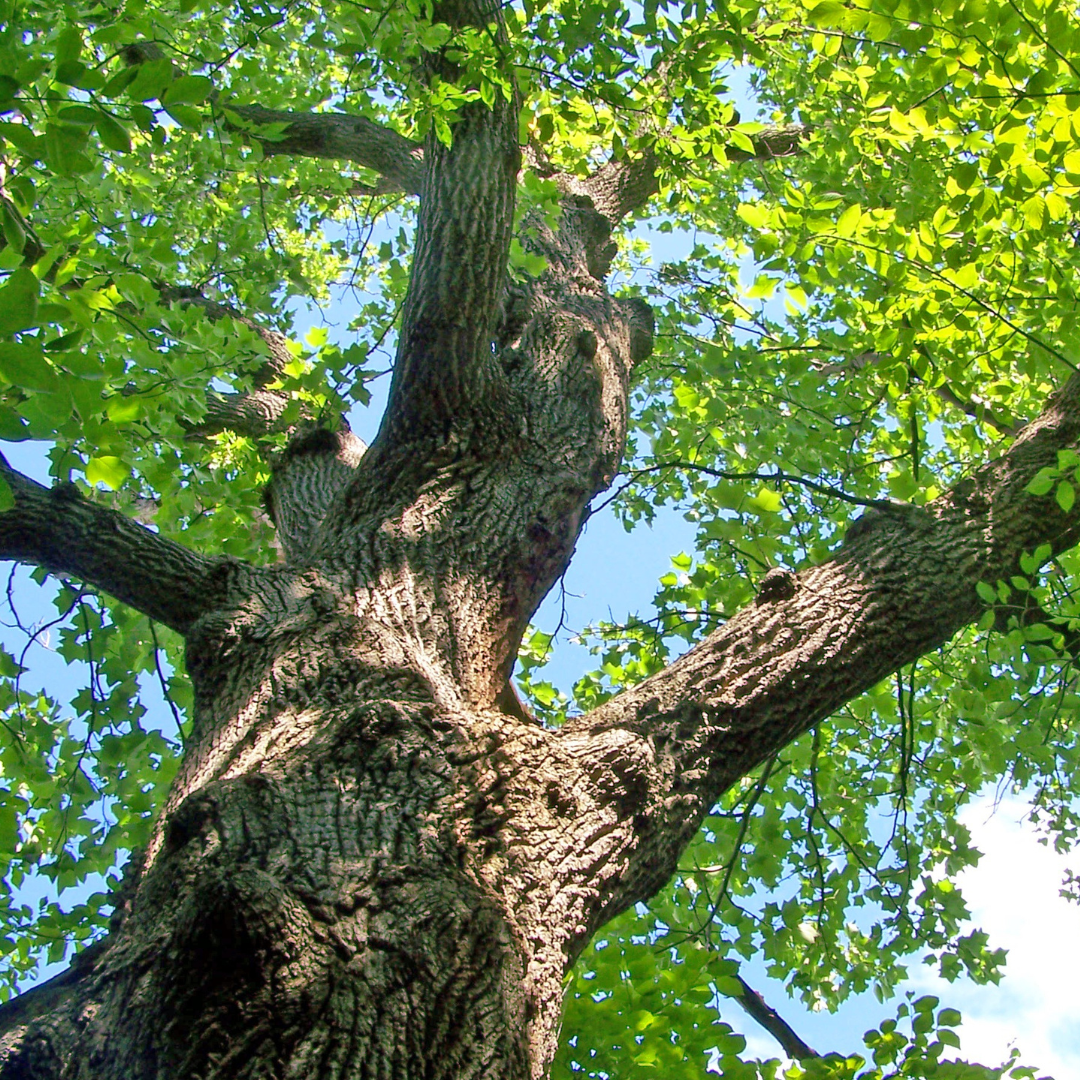
A homeowner can spot many warning signs, but some conditions are difficult to evaluate safely from the ground. Mature oaks and pecans can carry large loads high in the canopy, and internal decay may not be obvious from the outside.
A tree health assessment in Burleson, TX, Granbury, Cleburne, or Midlothian makes sense when the tree has been through severe weather, has developed new symptoms, or sits close enough to a home, driveway, fence, road, or other target that failure would create a meaningful problem.
That is where
tree health care in Cleburne, TX and surrounding North Texas communities becomes a decision process rather than a one-service recommendation.
There is no responsible flat price for tree service in Granbury, TX because weather-related tree work can range from a simple pruning visit to a complex removal involving rigging, heavy equipment, nearby structures, difficult access, or emergency response.
What Changes Tree Service Cost?.
A dead tree does not become harmless when its leaves disappear. As wood, roots, and branch attachments deteriorate, the tree loses strength and flexibility. Limbs can break without warning, roots can weaken below the soil, and the trunk may hide decay. That makes timely dead tree removal a property-safety decision rather than simple cleanup.
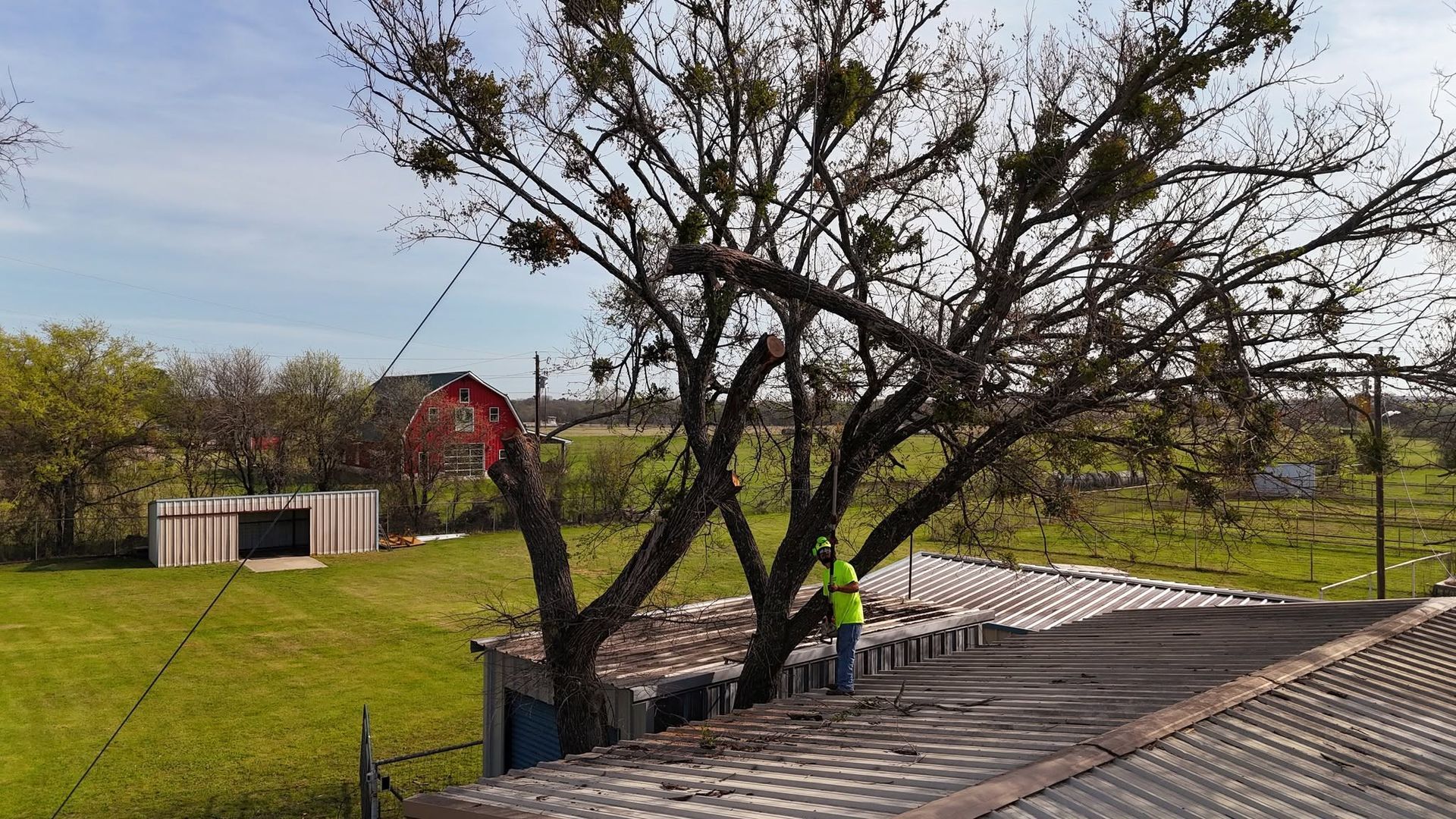
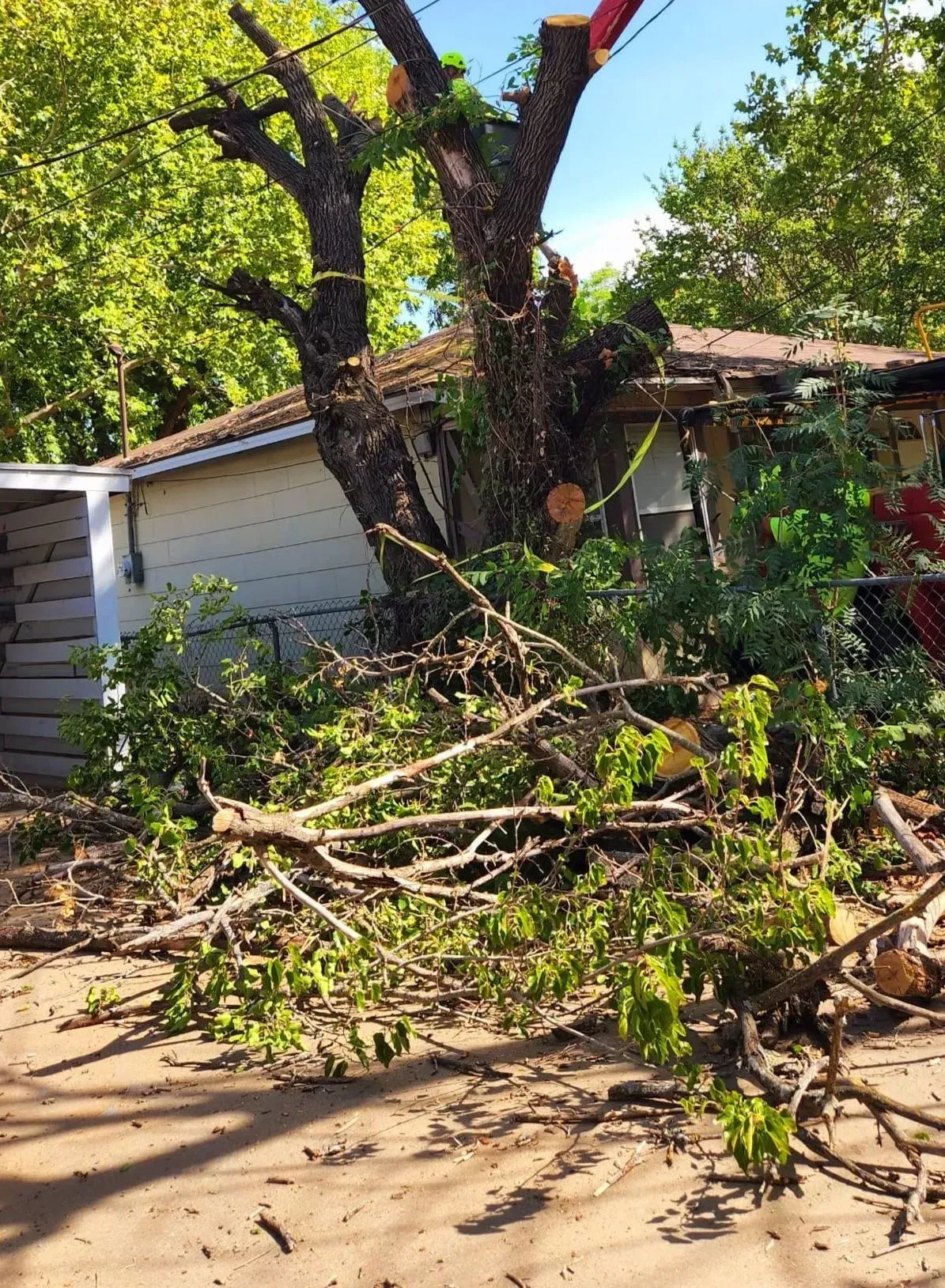
Removal becomes more complicated near a home, driveway, road, utility line, or neighboring property. The same decay that makes the tree dangerous can make it harder to climb, rig, and dismantle safely. Property owners need to know which signs increase urgency and what not to do nearby. This guide explains the decisions for Granbury properties and surrounding North Texas communities.
Why a Dead Tree Becomes Structurally Unpredictable
A living tree distributes forces through flexible wood, connected roots, and branch unions that respond to ordinary movement. After death, fungi, insects, moisture, heat, and weather begin changing those components at different rates. The upper crown may become brittle before the trunk looks damaged, or roots may decay while the visible stem still appears upright. Because deterioration is uneven, a tree can look stable from one angle while containing a weak point capable of failing under wind, vibration, or added load.
Dead trees also lose the ability to close wounds or produce new supportive growth. Bark may loosen, cracks can spread, cavities can enlarge, and branch attachments may weaken around hidden decay. The U.S.
Forest Service guidance on hazard trees notes that dead limbs and damaged trees may fall at any time and identifies missing bark, broken tops, conks, basal scars, and abundant woodpecker activity as possible warning signs. Not every dead tree will fail immediately, but waiting removes options as the structure becomes less dependable.
Dead Tree Risks at a Glance
Dead-tree risk depends on both the defect and the target. A deteriorated tree in an open field is a different problem from the same tree leaning over a bedroom, parking area, or public sidewalk. The table below shows why the assessment must consider what could fail, what could be struck, and how the tree can be accessed.
| Condition | Why it increases risk before removal | Why it complicates removal |
|---|---|---|
| Brittle crown or dead top | Limbs may release in wind or without obvious movement | The top may break during climbing, cutting, or equipment setup |
| Trunk cavity or advanced decay | Less sound wood remains to carry the crown | Normal cuts, hinges, and rigging forces may not behave predictably |
| Root or basal decay | The entire tree may lose anchorage | Equipment vibration or changing weight can affect stability |
| Heavy lean | The tree already carries unbalanced force | Each cut changes load and may accelerate movement |
| Hanging or lodged limbs | Material can fall into occupied areas | Workers must manage overhead hazards before other work proceeds |
| Nearby structures or fences | The drop zone contains valuable targets | Sections may need controlled lowering instead of open felling |
| Overhead utility lines | Contact can cause electrocution or service damage | Utility coordination or qualified line-clearance work may be required |
| Narrow gate or soft ground | Emergency access may become difficult | Bucket trucks, cranes, loaders, or chippers may need another setup |
Size alone does not determine danger. A small dead tree beside a playground or power line may deserve faster action than a large tree in an unused area. Wind, soil, recent storms, occupancy, and lean affect priority. An assessment connects the defect to a realistic failure path and target.
Warning Signs That Change the Urgency
Seasonal leaf loss should not be confused with death on deciduous trees. More concerning patterns combine crown decline, dead branches, bark loss, decay, or movement at the base. Inspect from a safe distance, and never shake, climb, or pull on a questionable tree to test it.
Contact a professional promptly when you notice:
- A new or increasing lean, particularly when the ground is lifting, cracking, or mounding on the opposite side.
- Large dead limbs or a broken top above a home, driveway, sidewalk, parking area, or used yard.
- Cracks or splits that extend through the trunk, a major union, or a large scaffold limb.
- Loose or missing bark, especially when exposed wood appears soft or hollow.
- Mushrooms, conks, cavities, or decay at the base, which may indicate internal wood or root deterioration.
- Hanging branches caught in the canopy, even if the main trunk remains upright.
- A dead tree near electrical conductors, service drops, transformers, or communication lines.
- Movement after wind or saturated soil, including exposed roots, soil gaps, or a changed canopy position.
If a tree has shifted, cracked, or dropped large material, keep people, pets, and vehicles outside its reach. Our
24/7 emergency tree service addresses fallen trees, dangerous leans, split stems, and storm damage. Do not collect debris while material remains overhead. The apparent cleanup area may still be an active failure zone.
Why Removal Is More Dangerous Than It Looks
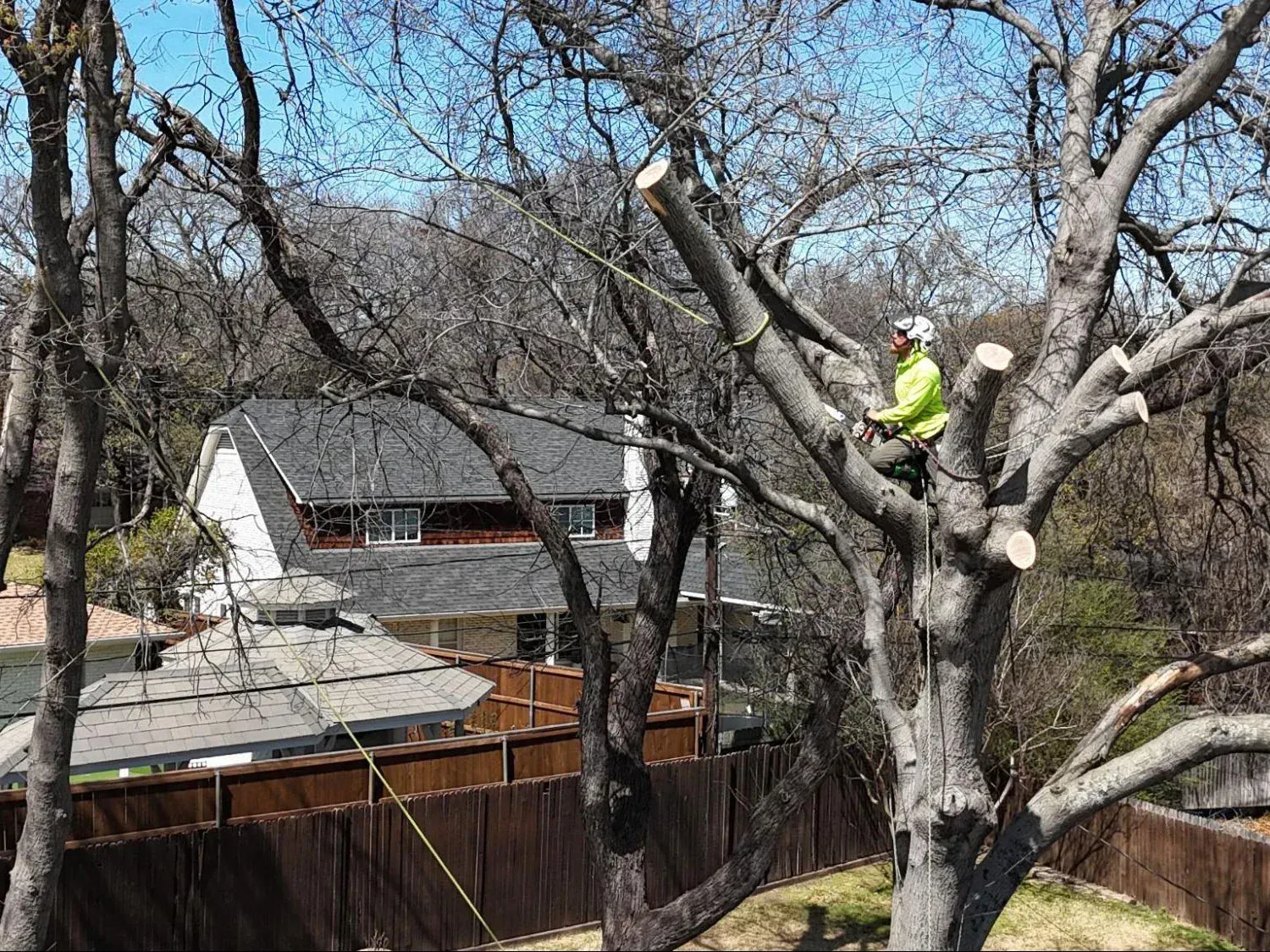
Removing a healthy tree already involves gravity, elevated work, sharp equipment, falling material, and rapidly changing loads. A dead tree adds uncertainty because a climber may not have a reliable tie-in point, a limb may break before the intended cut is complete, or a decayed trunk may not hold rigging forces. OSHA identifies falls and struck-by incidents as leading causes of serious injury in tree care and requires the tree and work site to be evaluated before operations begin. Its tree-care inspection guidance specifically addresses unstable trees, falling limbs, aerial devices, personal protective equipment, and safe anchor points.
Cutting also redistributes weight through the remaining structure. A dead top can release when a lower limb is moved, a lodged branch can spring or roll, and a leaning stem can react differently once supporting branches are removed. Dead wood may be lighter in some cases, but that does not make the job safer when fiber strength and connections are unreliable. This is why
dead tree removal safety depends on controlled access, suitable equipment, an exclusion zone, communication, and a plan that can change if hidden decay appears.
How Professional Dead Tree Removal Is Planned
The method is chosen after evaluating the tree, targets, access, and surroundings. Open felling may fit a clear site when remaining wood can support a controlled fall. Trees near structures often require sectional dismantling, mechanical access, or controlled rigging.
A professional plan commonly includes:
- Confirming the tree's condition from the crown to the root zone and identifying unstable tops, hangers, cavities, splits, and decay.
- Mapping the drop zone and targets, including buildings, vehicles, fences, roads, and neighboring property.
- Checking overhead and underground conflicts, such as electrical lines, service drops, septic components, irrigation, and buried utilities.
- Selecting access and equipment, such as an aerial lift, crane, loader, rigging system, or ground protection.
- Establishing an exclusion zone so residents, pedestrians, pets, and unnecessary workers remain outside the work area.
- Choosing the removal sequence so the most unstable material is addressed without loading weak attachment points.
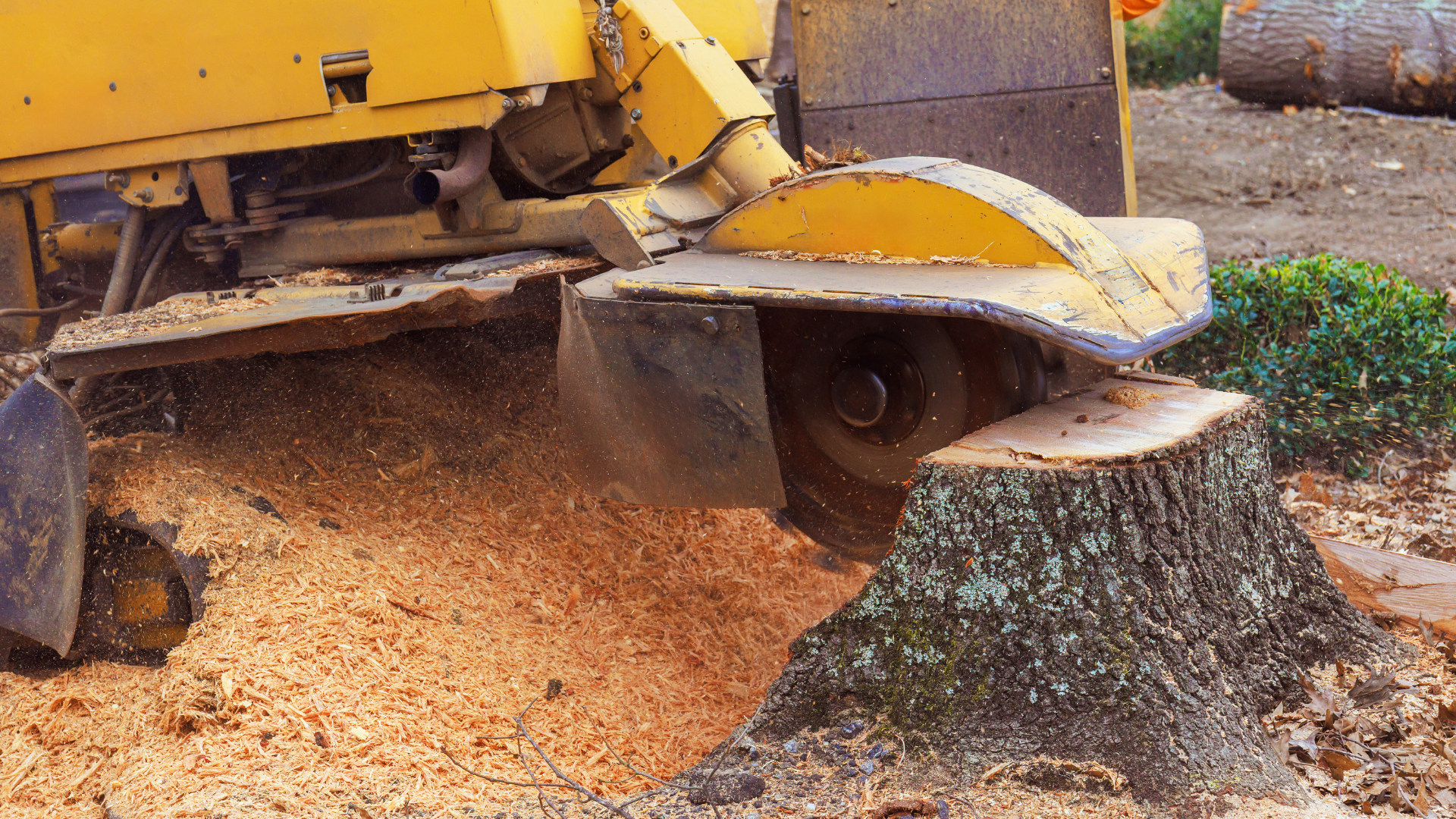
- Planning debris handling, including chipping, haul-away, firewood requests, and stump grinding.
The plan may change when initial cuts reveal internal decay. That is a responsible response to newly visible conditions. We explain the approach before work and keep the site controlled throughout removal. Our
professional tree removal service focuses on removing hazards while protecting the property.
What Dead Tree Removal May Cost
We provide free, project-specific estimates because an online price cannot show the condition, access, targets, equipment, or cleanup needs. A standing dead tree may require more controlled work than a healthy tree of similar size because its crown, trunk, roots, and anchor points may be unsound. Stump grinding, log removal, emergency timing, crane access, and utility coordination also change the scope.
For independent planning context, HomeGuide's
2026 tree removal cost guide lists
$400 to $1,200 as a national average range, with accessible small trees near
$200 and complex work at
$3,000 or more. These figures are not our pricing or a Granbury quote. A dependable estimate explains the removal method, inclusions, and site conditions.
| Cost factor | Why it matters | Question to ask about the estimate |
|---|---|---|
| Height and trunk diameter | Larger trees create more cutting, rigging, and debris | Is the full tree included or only selected sections? |
| Decay and instability | Weak wood may limit climbing and conventional rigging | What access method will be used? |
| Proximity to targets | Homes, fences, roads, and landscaping reduce the drop zone | Will sections be lowered or lifted? |
| Equipment access | Gates, slopes, septic areas, and soft ground restrict machinery | Is special equipment or ground protection included? |
| Utility conflicts | Electrical hazards can require coordination and special qualifications | Who handles utility communication? |
| Debris disposition | Chipping, hauling, log cutting, and cleanup require time | What material remains after the job? |
| Stump work | Grinding is often a separate phase | Is stump grinding included and to what depth? |
| Emergency timing | Immediate response can require rapid mobilization | Is the work preventive or an active emergency? |
Compare estimates line by line. One may include haul-away, cleanup, and stump grinding, while another stops after the trunk is down. Confirm equipment, ground protection, and disposal. Favor a clear method and written scope, not automatically the lowest total.
A Decision Framework for How Quickly to Act
Not every dead tree needs emergency response, but every confirmed dead tree needs a plan. Timing should reflect failure potential, exposure, and consequences. Use this framework to organize the next step, knowing that an onsite assessment may change the priority.
| Observed condition | Practical response | Why |
|---|---|---|
| Dead tree in an open, unused area with no reachable targets | Schedule an assessment and planned removal | Lower exposure does not stop ongoing decay |
| Dead limbs over a driveway, sidewalk, play area, or entrance | Restrict the area and request prompt evaluation | A partial failure could injure someone before the trunk fails |
| New lean, cracked soil, or visible root movement | Keep clear and seek urgent professional assessment | Root-plate movement can precede whole-tree failure |
| Split trunk, hanging top, or tree lodged against another tree | Treat as an emergency and isolate the area | Stored forces and unsupported material are unpredictable |
| Dead tree touching or threatening utility lines | Stay away and contact the utility or qualified professionals | Electricity can energize the tree, tools, or surrounding ground |
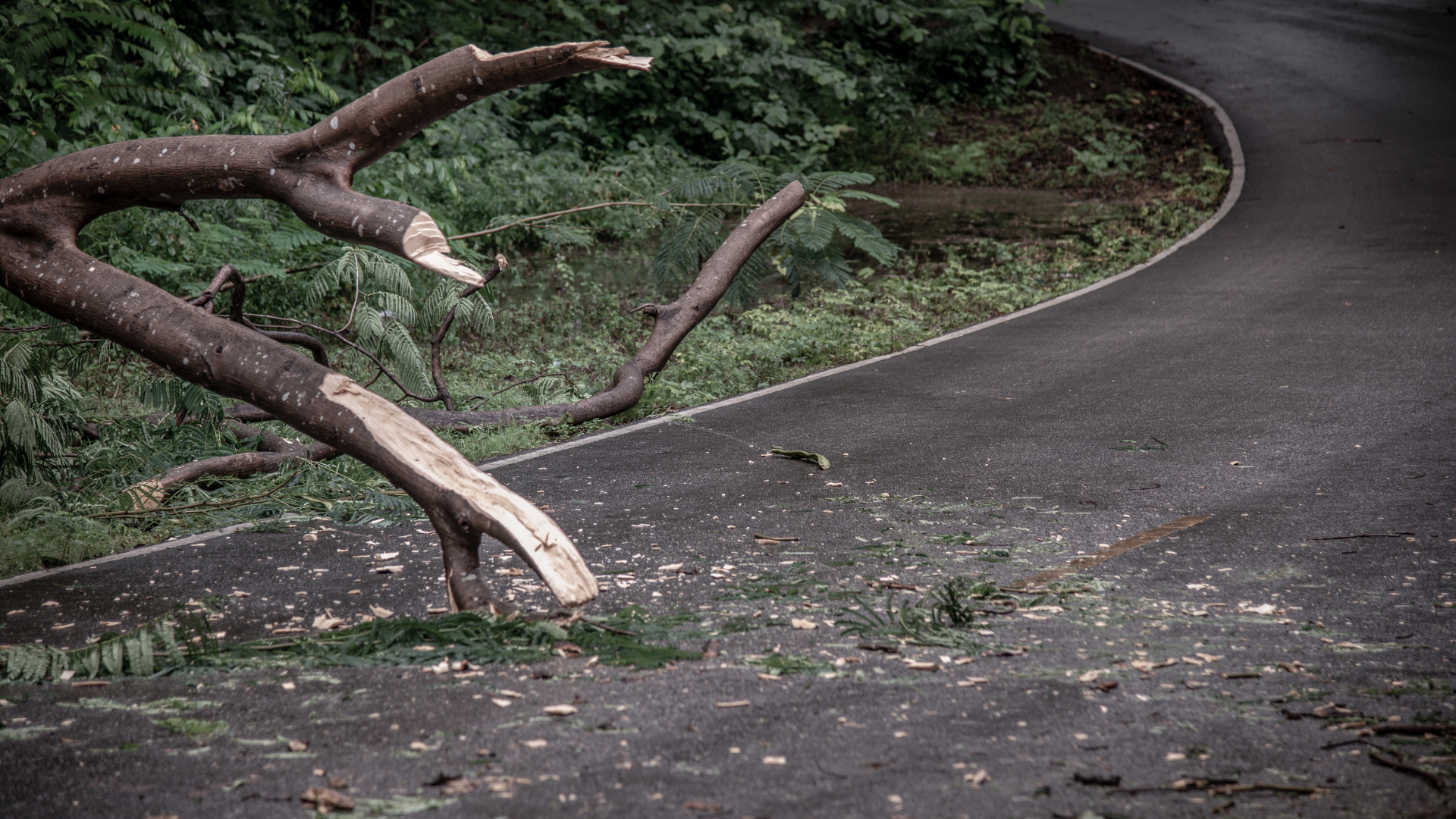
| Tree or large limb already on a structure or blocking access | Use emergency service and avoid the affected area | Movement during cleanup can cause secondary damage or collapse |
This framework applies across Granbury, Burleson, Benbrook, and Fort Worth, but the site controls the recommendation. A Granbury tree may have open access but uneven terrain, while a Fort Worth or Benbrook tree may sit between structures and utility lines. Burleson properties range from compact lots to larger tracts with different access. We evaluate those conditions instead of assigning urgency by ZIP code.
What to Do Before the Removal Crew Arrives
Property owners can reduce exposure without touching the tree. Keep the area accessible and free from people or objects that complicate the response. If conditions are changing, prioritize distance and wait for professional direction.
Safe preparation includes:
- Keep children, visitors, tenants, workers, and pets outside the tree's possible fall area.
- Move vehicles and portable items only when they can be reached without passing under the tree.
- Do not attach ropes, winches, chains, ladders, lights, or decorations to the trunk or branches.
- Avoid mowing, digging, trenching, or driving heavy equipment over a weakened root zone.
- Photograph visible conditions from a safe location for reference or an insurance conversation.
- Identify gates, septic areas, irrigation, lighting, and known underground features for the crew.
- Notify neighbors when the work zone may affect a shared drive, fence line, or street.
- Follow utility instructions when any part of the tree is near electrical lines, and assume all lines are energized.
OSHA's
line-clearance guidance explains that specialized training and approach distances apply near energized conductors. Never separate a branch from a line or use a pole tool nearby. A fallen wire and surrounding ground can remain dangerous. Keep everyone back until the utility or qualified personnel confirms safety.
Frequently Asked Questions
Can a completely dead tree remain standing for years?
Some dead trees remain upright for years, while others fail quickly. Species, roots, decay, wind, soil, and prior damage affect the timeline. Standing duration does not prove stability because components deteriorate at different speeds. A dead tree near a target needs assessment and a plan.
Is a dead tree easier or cheaper to remove than a live tree?
Not necessarily. Brittle limbs, root decay, cavities, and weak anchor points can require controlled dismantling or more equipment. A fallen tree in an open area may be simpler to process, but waiting can cause damage or an emergency. Cost depends on the condition and work zone.
Can I cut down a small dead tree myself?
Size is only one part of risk. Lean, dead tops, decay, lines, lodged branches, and reachable targets can make a small tree hazardous. Never climb a dead tree or work near electrical conductors. If the fall path is not completely open and predictable, seek professional assessment.
Does homeowners insurance pay for dead tree removal?
Coverage depends on the policy, cause of loss, property damage, and whether removal is preventive. A standing dead tree may be treated differently from storm cleanup after structural damage. Document conditions safely and ask the insurer for a policy-specific answer. Do not delay an urgent response while waiting on coverage.
Should a stump be ground immediately after removal?
Stump grinding can follow removal, but it is a separate decision based on access, future use, and trip risk. The crew needs to know about utilities, irrigation, septic components, and other underground conflicts. Emergency work may make the tree safe first and schedule grinding later. Ask for the stump scope in writing.
What should I do if a dead tree is near a power line?
Keep away and assume the conductor is energized. Do not touch branches, fences, tools, or vehicles that may contact the line. Contact the utility and qualified professionals to establish safe responsibilities. Call emergency services for arcing, fire, a downed line, or an immediate threat.
Schedule Dead Tree Removal Before Failure Limits the Options
A dead tree becomes harder to manage as decay removes reliable wood, roots, and attachment points. We assess the entire work zone, explain the removal method, establish a controlled area, and match equipment to the tree and property. Addressing the problem before a limb falls or the root plate shifts can preserve more scheduling and access options. It can also protect the people, structures, vehicles, and neighboring areas within reach.
If you are concerned about a dead or unstable tree in Granbury, Burleson, Benbrook, Fort Worth, or a surrounding community, contact us for an onsite estimate. We will determine whether the condition needs scheduled professional tree removal or a faster emergency response. Use our contact page to describe the tree, its location, and any recent change you have observed. If the tree is moving, split, on a structure, or near an energized line, keep clear and call for immediate help.
Don’t wait for the next storm to test your trees.
👉 Worried about a tree near your roof, driveway, or power lines?
Contact Branch Boss Tree Co. today to schedule your summer tree assessment and get expert trimming
that protects your property and peace of mind.
Call us today at
817-487-8448 to let us handle your tree and tree stump removal needs with professionalism and care.