What to Do After a Tree Falls on Your Property in Granbury TX
When a tree comes down on a Granbury property, whether it hits the roof, blocks the driveway, falls across a fence line, or lands in the yard, the first reaction for most homeowners is to go outside and assess the damage. That instinct is understandable. It is also one of the most dangerous things you can do in the immediate aftermath.
A fallen tree is not a static situation. Power lines may be down and in contact with the tree or the surrounding ground. The tree itself may be partially suspended, with tension in branches or the root system that can shift suddenly when weight is redistributed. And the structure the tree hit, whether a roof, a wall, or a carport, may be compromised in ways that are not obvious from the outside.
Branch Boss Tree Co. provides 24/7 emergency tree services throughout Granbury, Hood County, and the surrounding North Texas communities. The calls that come in after severe weather follow a consistent pattern, and so do the mistakes homeowners make in the first hour after a tree goes down. This guide covers what to do, what not to do, and how to move from the moment the tree falls through the insurance process and final cleanup.
Why Hood County and Johnson County See So Many Fallen Trees
A tree falling on a Granbury property is not a random event. It is the result of a specific combination of weather, soil conditions, and tree health factors that make Hood County and the surrounding North Texas region one of the most consistent markets for storm tree damage in the state.
The NOAA National Weather Service Fort Worth office documents that North Texas is among the most storm-active regions in the country. In the April 2026 severe weather outbreak alone, NWS Fort Worth recorded 287 storm reports over six consecutive days, including softball-sized hail confirmed in Hood County near Granbury, tornadoes in Johnson County, and 37 reports of damaging wind gusts exceeding 60 mph across the region. The NWS described that event as the most damaging severe storm outbreak in the Fort Worth county warning area since June 2025.
That level of storm intensity is not exceptional for this part of Texas. It is the seasonal pattern. Hood County sits in a corridor where storm systems moving northeast from the Texas Hill Country combine with Gulf moisture to produce the hail, straight-line winds, and tornado activity that recur across Granbury, Burleson, Cleburne, and Midlothian every spring and early summer.
The tree health dimension compounds the storm damage risk. North Texas has experienced significant drought stress over the past several years. Mature oaks, pecans, and cedars across Granbury and Hood County properties carry drought-weakened root systems and internal decay that is not visible from the ground. When a storm arrives, trees that appeared healthy from the outside fail because the structural integrity that kept them upright was already compromised before the first wind gust hit.
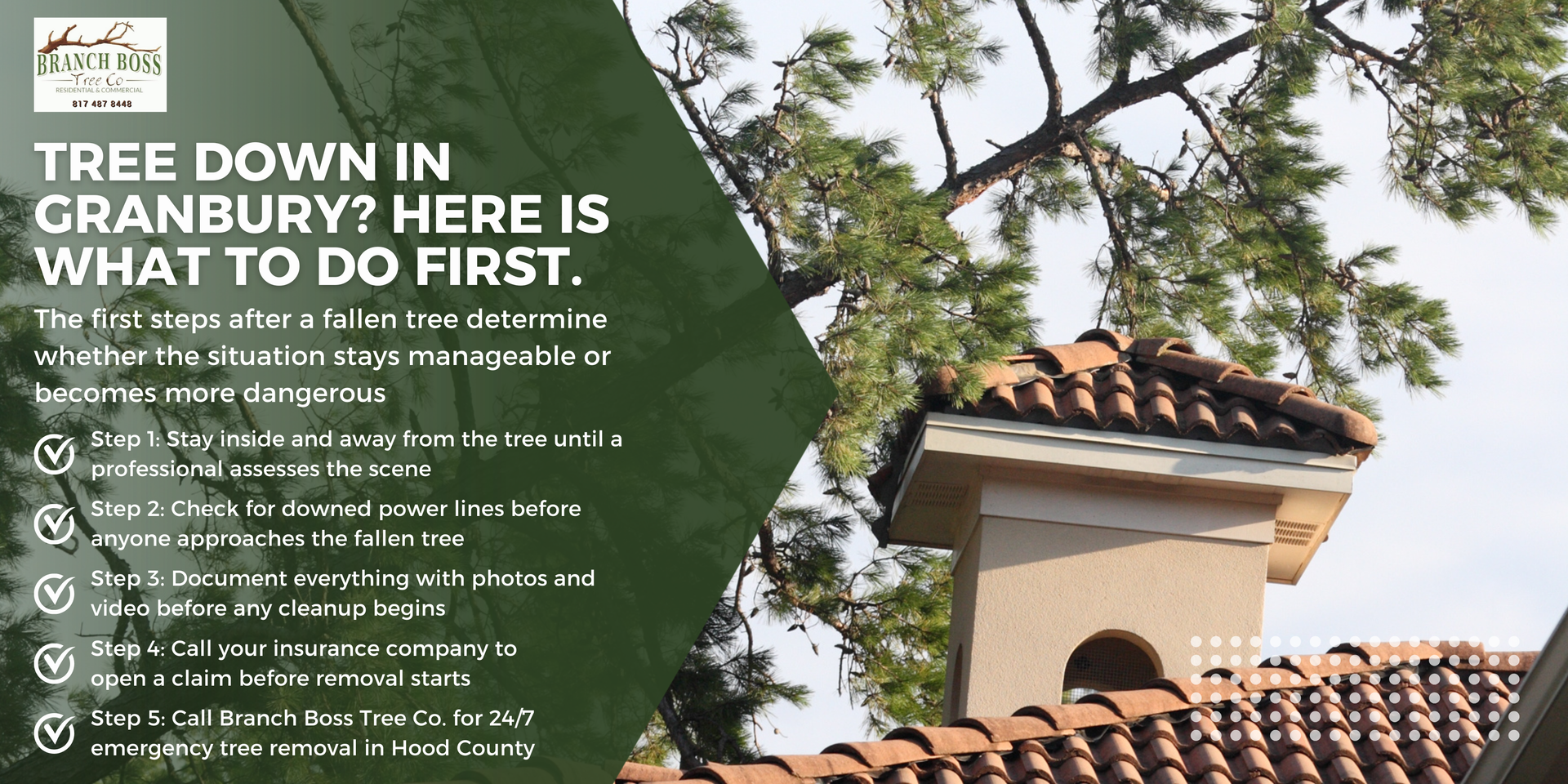
Step 1: Stay Away From the Tree Until the Scene Is Assessed
The most important action in the first few minutes after a tree falls on a Granbury property is to keep everyone away from the area.
A tree that has fallen into a structure may appear stable but is almost never fully at rest. Root plates can shift as soil redistributes under the changed weight load. Partially broken branches still suspended in the canopy, what arborists call hangers or widow makers, can fall without warning when the tree below them is disturbed. The USDA Forest Service specifically notes that storm-damaged limbs can fall long after the weather event has passed, with no additional wind or movement required to trigger the release.
If the tree is in contact with or near a power line, the danger zone extends well beyond the tree itself. Downed power lines can energize the surrounding ground, the structure the tree hit, and any water or wet vegetation in the area. Do not approach, touch, or attempt to move anything near a downed line. Call Oncor or your local utility provider immediately and wait for the line to be confirmed dead before anyone enters the area.
The time to begin visual documentation is from inside the house or from a safe distance, not from directly beside or under the fallen tree.
Step 2: Document Before Anyone Touches Anything
Insurance claims for fallen tree damage succeed or fail on documentation. The condition of the tree, the point of impact, the extent of structural damage, and the position of the tree at the time of the storm event are all details that an insurance adjuster will need and that become impossible to document accurately once cleanup begins.
Before Branch Boss or any contractor removes the tree or begins any cleanup work, photograph and video everything from every angle you can safely access.
What to document:
- The full length of the fallen tree from root plate to canopy
- The point where the tree made contact with the structure, fence, vehicle, or landscape
- Any visible damage to the structure at the contact point and surrounding areas
- Interior ceiling and wall conditions if the tree penetrated the roof
- Any additional trees on the property that are leaning, cracked, or showing storm damage
- The overall site condition from multiple angles before anything moves
Branch Boss Tree Co. also documents conditions upon arrival at every emergency call in Granbury and Hood County. That documentation supports the insurance claim process and establishes a clear record of what the site looked like before any work began.
Step 3: Call Your Insurance Company Before Removal Starts
Most homeowners in Granbury and Hood County call a tree service before they call their insurance company. That sequence creates problems.
An insurance adjuster may need to physically inspect the fallen tree and the point of impact before authorizing payment for removal. If the tree is removed before that inspection, the documentation you created with photos and video becomes the only evidence of the damage condition.
In some cases, insurers may dispute the scope of damage if they cannot inspect the scene directly.
The right sequence is:
- Call your insurance company to open a claim and ask whether they need to inspect before removal begins
- Get confirmation in writing or by email of what they authorize
- Call Branch Boss for emergency tree service
If the fallen tree has breached the structure and the home is exposed to weather, most insurance policies allow emergency mitigation, boarding, tarping, and water protection, to proceed before a formal adjuster visit. Branch Boss Tree Co. can assist with emergency tree removal in situations where exposure is creating ongoing damage, and can document the scope before and after the work in a way that supports the insurance claim.
For more detail on how insurance typically handles storm tree damage in Texas, the Texas Department of Insurance provides guidance specifically on storm damage claims and what homeowners should expect from the claims process.
How Texas Homeowners Insurance Handles Fallen Tree Damage
Whether your insurance covers fallen tree damage in Granbury depends on two things: where the tree came from and what it hit.
If a tree falls on your structure: Damage to the structure itself, the roof, walls, carport, fence, or attached garage, is typically covered under the dwelling coverage in a standard Texas homeowners insurance policy. The tree removal cost is usually covered up to a per-tree limit specified in the policy, often in the range of $500 to $1,000 per tree, with the remainder the homeowner's responsibility.
If a tree falls in your yard without hitting a structure: A tree that comes down in the yard and does not damage a covered structure is generally not covered for removal under a standard policy. The tree has to hit something for most policies to trigger removal coverage.
If your neighbor's tree falls on your property: If the neighbor's tree was healthy and fell due to a storm event, your insurance typically handles the claim on your property, and the neighbor's policy is generally not involved. If the tree was dead, diseased, or visibly hazardous before it fell and the neighbor was notified of the condition, the analysis is more complex and may involve the neighbor's liability coverage.
The deductible: Most Texas homeowners policies have separate wind and hail deductibles that apply to storm damage claims. These are often higher than the standard policy deductible and are typically expressed as a percentage of the home's insured value rather than a flat dollar amount. Knowing your wind and hail deductible before a storm season is important context for understanding what a storm damage claim will actually cost you out of pocket.
Does Insurance Cover Your Fallen Tree in Granbury? Here Is the Quick Answer.
| Typically Covered | Typically Not Covered |
|---|---|
| Tree falls on your home, roof, fence, or attached structure during a storm | Tree falls in the yard without hitting a covered structure |
| Tree falls on a detached garage or carport and causes structural damage | Removal of trees that are leaning or hazardous but have not yet fallen |
| Tree falls on a vehicle parked in a covered structure (check auto policy for unattached) | Damage caused by a tree you knew was dead or diseased and did not address |
| Emergency tarping or boarding to prevent further damage to the structure | Stump grinding after tree removal in most standard policies |
| Tree removal cost up to the per-tree limit specified in the policy | Tree removal that exceeds the per-tree limit in the policy |
What the Emergency Tree Removal Process Looks Like
When Branch Boss Tree Co. arrives at a Granbury property for an emergency tree call, the process follows a specific sequence regardless of storm size or tree size.
Scene assessment first. Before any equipment is deployed or any cutting begins, the crew assesses the full situation. Where is the tree in contact with the structure? Are there hangers in the canopy? Is the root plate stable? Are there power lines involved? Is the structure beneath the tree compromised enough to affect safe access? That assessment determines the approach, the equipment needed, and the sequence of cuts.
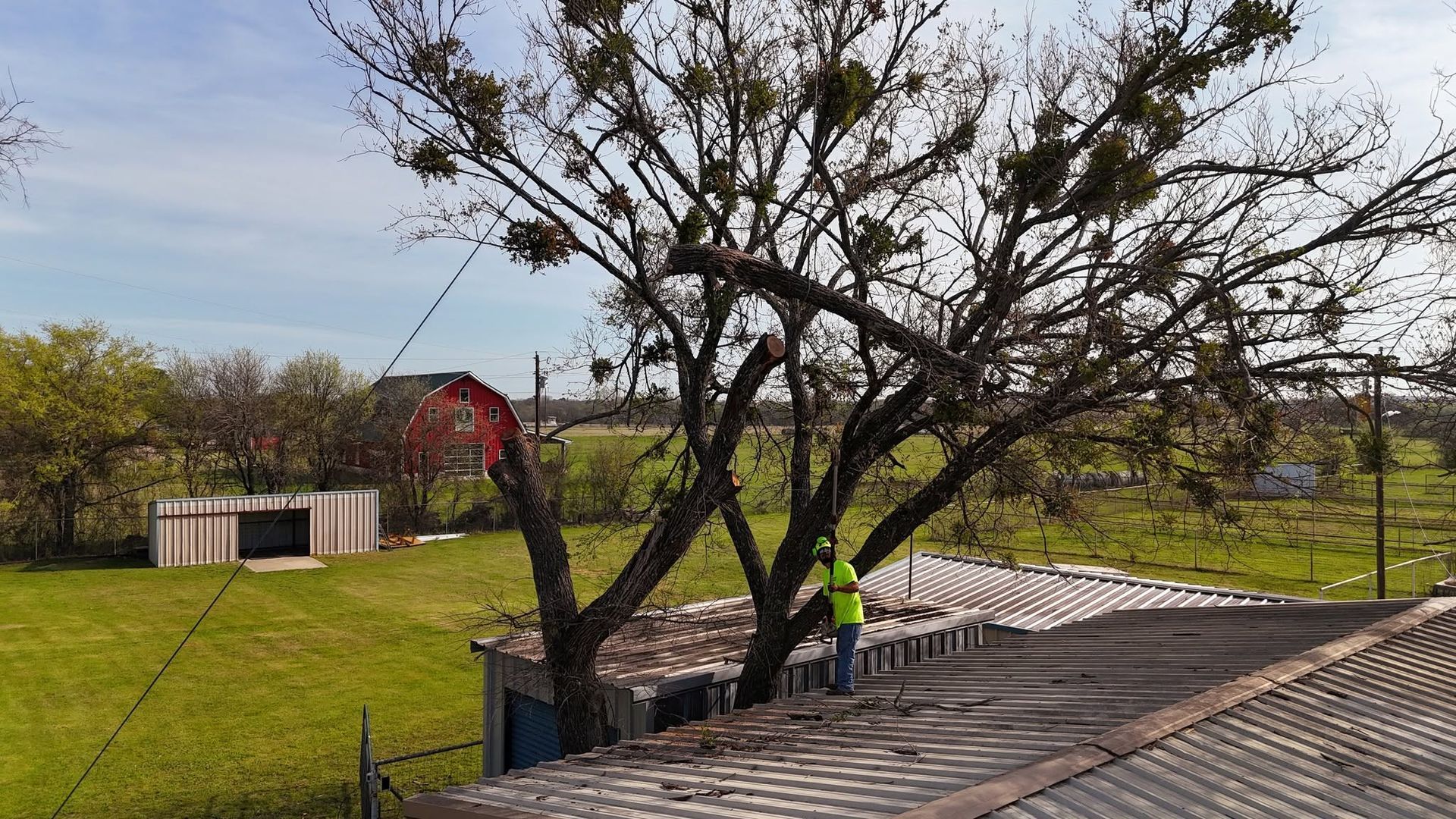
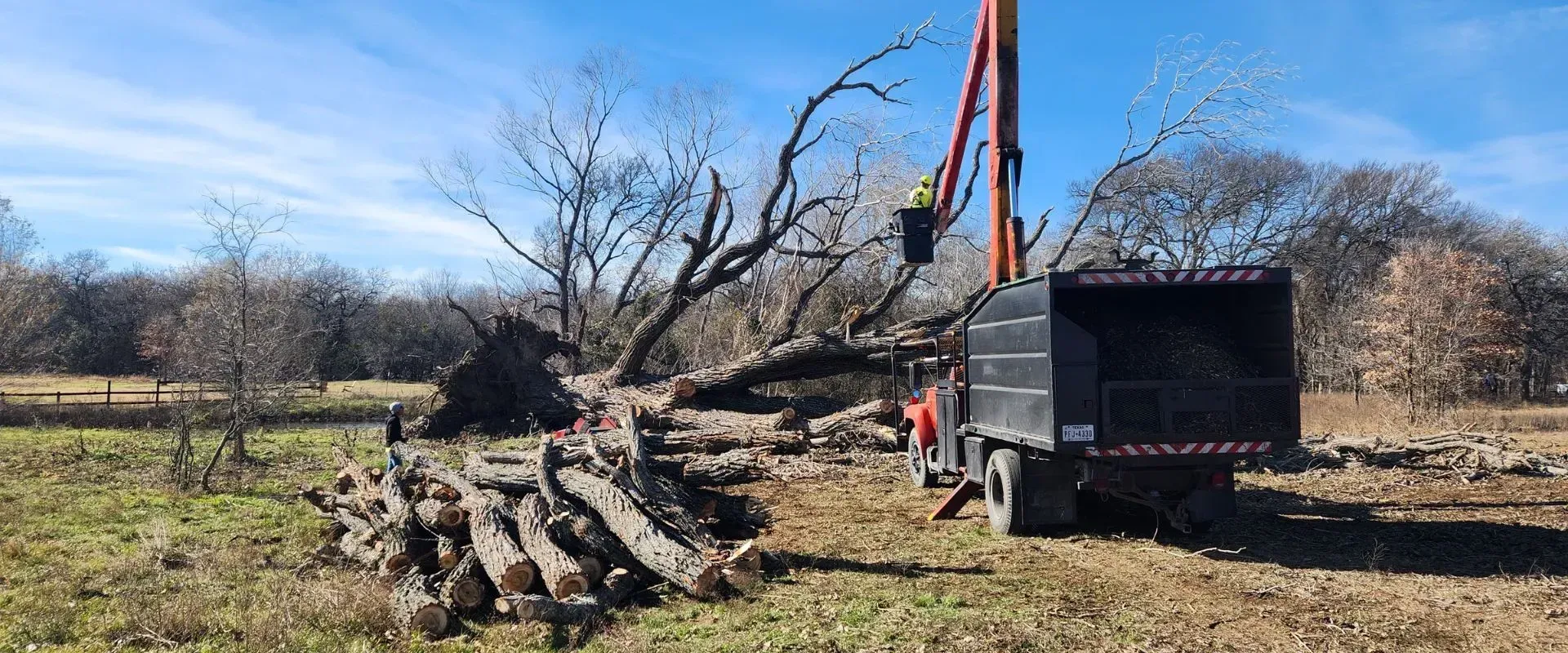
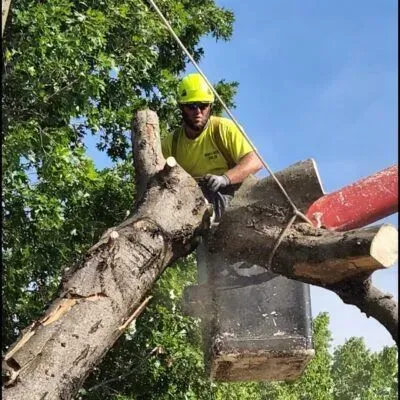
Rigging and controlled removal. A tree that has fallen into a structure cannot simply be cut at the base and pushed away. The weight distribution, the tension in the wood, and the position of the canopy relative to the structure all determine how each section needs to be rigged and lowered rather than dropped. Branch Boss uses rigging, climbing equipment, and mechanical support to remove trees from structures in sections, controlling where each piece lands rather than adding impact load to an already stressed building.
Documentation throughout. The crew documents conditions before, during, and after removal to support the insurance claim and to establish a clear record of the work completed.
Site cleanup to completion. Branch Boss treats cleanup as part of the job, not an afterthought. Limbs, debris, and wood are removed from the property. The site is left in a condition the homeowner can present to an insurance adjuster or a roofing or repair contractor on the same day the tree comes out.
Assessment of remaining trees. One of the most consistent follow-up concerns after a fallen tree in Granbury is the condition of the trees that did not fall. A storm severe enough to bring one tree down frequently stresses adjacent trees in ways that create future hazards. Branch Boss evaluates the remaining canopy on the property and advises on any trees that warrant monitoring or removal before the next storm season.
For more on how Branch Boss handles the full scope of storm response, the
emergency services page describes the 24/7 response process throughout Hood County, Johnson County, and the surrounding North Texas service area.
Branch Boss deploys forestry mulching across a range of Johnson County and North Texas projects. These are the applications where the method consistently outperforms traditional alternatives.
What to Do About Remaining Trees After a Storm
A tree falling on a Granbury property is often the visible symptom of a larger issue: multiple trees on the property that absorbed the same storm stress and are now in a compromised condition.
After any significant storm event in Hood County, homeowners should walk their property when it is safe to do so and look for the conditions that indicate a tree may fail in a subsequent weather event.
New leaning that was not present before the storm is the clearest indicator. A root plate that has shifted during the storm may continue moving in saturated soil for days after the event. Any tree that has developed a new lean toward a structure, a vehicle, a fence line, or a power line warrants professional assessment before the next storm system arrives.
Visible cracks in the trunk or at branch unions, hanging branches caught in the canopy rather than falling cleanly, and soil heaving or cracking at the base of the tree are all conditions that the USDA Forest Service identifies as indicators of potential tree failure. Addressing these conditions before a second storm arrives is significantly less expensive and less disruptive than emergency removal after a second tree comes down.
Branch Boss Tree Co.'s
tree removal service covers hazardous tree evaluation and removal throughout Granbury, Cleburne, Burleson, Midlothian, and Hood County. The team assesses each tree individually and gives honest recommendations on whether removal, trimming, or monitoring is the appropriate response.
Frequently Asked Questions
What should I do first if a tree falls on my house in Granbury?
Stay inside and away from the tree. Check whether any power lines are down or in contact with the tree or structure and call Oncor if they are. Once it is safe, document the scene thoroughly with photos and video from every angle you can reach safely. Then call your insurance company to open a claim before any removal begins. Branch Boss Tree Co. is available 24/7 at (817) 487-8448 for emergency tree removal throughout Hood County.
Will my insurance company pay for the tree to be removed if it fell in my yard but did not hit anything?
In most standard Texas homeowners policies, tree removal is only covered when the tree has damaged a covered structure. A tree that falls in the yard without hitting a structure is typically not covered for removal. Review your specific policy language or call your agent for confirmation. Branch Boss can provide a written estimate for removal if the cost falls outside what insurance covers.
How quickly can Branch Boss respond to a fallen tree emergency in Granbury?
Branch Boss Tree Co. provides 24/7 emergency response throughout Granbury and Hood County. Response time varies depending on the volume of storm calls in the area following a significant weather event, but the team prioritizes situations where a tree has breached a structure or where ongoing exposure to the elements is creating additional damage.
Can I cut up the tree myself to remove it from my roof?
In most situations, this is not advisable. A tree that is resting on a roof is under tension and weight loads that change when sections are cut. Removing sections without understanding where that tension is redirected can cause the remaining tree to shift suddenly and cause additional structural damage or injury. Branch Boss has the equipment and training to assess those tension points and remove the tree safely in the correct sequence.
Does Branch Boss handle both the tree removal and the stump after a storm?
Yes. Branch Boss provides stump grinding following tree removal throughout Granbury and the surrounding area. Stump grinding is typically not covered by homeowners insurance following a storm claim, but Branch Boss includes it as an available service so the homeowner can address the full situation with one contractor rather than coordinating a separate stump service.
Should I have the rest of my trees inspected after a storm?
Yes. A storm severe enough to bring one tree down frequently stresses adjacent trees in ways that create future hazards that are not immediately visible. Branch Boss evaluates the full property canopy after emergency removals and advises on any additional trees that warrant attention before the next storm season. That evaluation is part of the service, not a separate charge.
If you are dealing with storm damage, a fallen tree, or hazardous trees on your property in Granbury, Cleburne, Burleson, or the surrounding North Texas area, Branch Boss Tree Co. can evaluate your property and recommend the safest, most practical solution. The team is available 24/7 and responds to emergency calls throughout Hood County and Johnson County.
Don’t wait for the next storm to test your trees.
👉 Worried about a tree near your roof, driveway, or power lines?
Contact Branch Boss Tree Co. today to schedule your summer tree assessment and get expert trimming
that protects your property and peace of mind.
Call us today at
817-487-8448 to let us handle your tree and tree stump removal needs with professionalism and care.